
Sourcing swimwear in China can give startup brands access to mature fabric supply chains, digital printing, trims, packaging and experienced swimwear production. But the result depends on how clearly the project is prepared. A vague request often leads to unclear quotes, repeated samples and avoidable delays.
This guide explains how a startup should approach China swimwear sourcing step by step: define the product, prepare a tech pack, choose fabrics, manage MOQ, review samples and evaluate the manufacturer before bulk production.
Start With a Clear Product Brief
Before contacting suppliers, define what you are actually asking them to make. A useful brief should include product type, target customer, quantity range, size range, fabric direction, target price, preferred launch date and whether the project is private label, ODM or full custom.
If you are still unsure which production model fits your budget, compare the options in the private label vs custom swimwear guide. This decision affects cost, MOQ and lead time from the beginning.
Prepare a Tech Pack Before Custom Sampling
For custom swimwear, a tech pack is the bridge between your design idea and the factory’s production team. It should include technical flats, measurements, grading, fabric information, lining, elastic, pads, hardware, stitching notes, labels and packaging requirements.
A clear swimwear tech pack helps the supplier quote more accurately and produce a sample that can be evaluated properly. Without it, the first sample may only be an interpretation of your idea rather than a controlled development step.
Use Fabric Strategy to Control MOQ
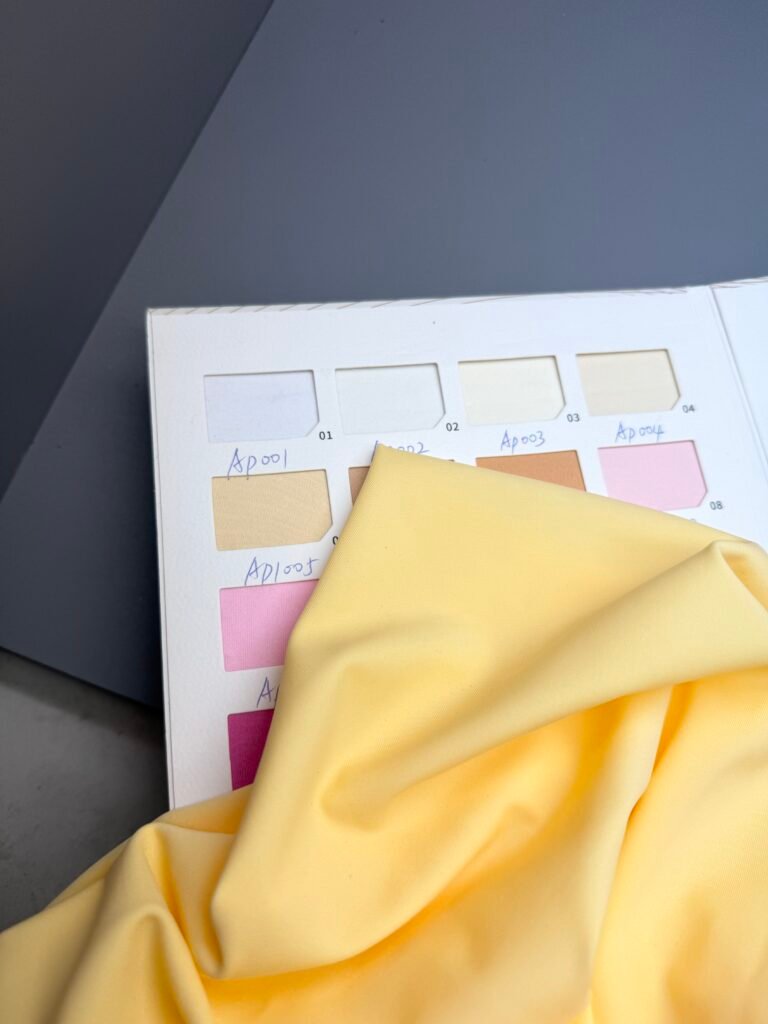
Fabric is one of the biggest advantages of sourcing in China, but it is also where new brands can overspend. Stock colors and proven fabric bases can reduce risk for early launches, while custom-dyed colors and special materials may increase MOQ and development time.
- Stock colors: better for testing the market with lower commitment.
- Custom colors: useful for brand identity but usually require higher fabric MOQ.
- Printed fabrics: can be flexible, but print method and base fabric must match the design.
- Special fabrics: recycled, textured or high-performance materials need earlier confirmation.
Before finalizing material choices, review the swimwear fabric selection guide so your sourcing request is specific enough for production.
Manage MOQ With a Smaller SKU Plan
MOQ is easier to manage when your first collection is focused. Too many silhouettes, colors and sizes split the budget and make production harder to control. For a startup, a smaller SKU plan with stronger depth is often better than a broad collection with weak inventory in every style.
Discuss MOQ by style, color and fabric. Also ask whether trims, labels or packaging have separate minimums. These details affect the real launch budget, not just the garment unit price.
Evaluate the Supplier Before Bulk Production
Do not judge a supplier only by the first quote. Evaluate their fabric knowledge, sample quality, communication, quality control process, lead time, compliance support and willingness to explain cost drivers. The hub article on how to evaluate swimwear manufacturers gives a full checklist.
If you cannot visit the factory, use a structured video call to review sample areas, production lines, inspection procedures and packaging. This is especially useful before placing a larger order with a new supplier.
Understand the Total Cost, Not Only Unit Price
China sourcing can be cost-effective, but the decision should be based on landed cost. Include factory price, freight, duties, payment fees, inspection, packaging and possible sample revisions. A cheaper quote can become expensive if communication is poor or quality problems require rework.
For US buyers or brands comparing trading companies with direct factories, the guide on reducing swimwear import costs by buying direct from a China factory explains how supplier structure affects landed cost.
A Practical Startup Sourcing Path
- Define your production model: private label, ODM or full custom.
- Prepare a product brief or tech pack before requesting samples.
- Choose fabric and trim options that fit your budget and MOQ.
- Evaluate the manufacturer using quality, communication and delivery metrics.
- Start with a controlled first order, then use sales data to plan reorders.
For a startup brand, the goal is not to find the cheapest supplier. The goal is to build a supply chain that can support your first launch without creating avoidable inventory, quality or timing problems.