
swimwear manufacturer&supplier in China – Hongxiu Clothing Co., Ltd.

For US swimwear brands and retailers, the financial impact of US-China tariffs is a direct line item on the balance sheet. The 25% duty applied to most apparel imports significantly inflates your landed cost. A traditional sourcing model, which layers agent or trading company markups on top of factory prices, compounds this burden. This guide outlines a strategic alternative: establishing a direct partnership with a swimwear manufacturer in China. This approach isn’t just about avoiding a middleman’s fee; it fundamentally recalibrates the cost base upon which tariffs are calculated, leading to substantial, sustainable savings and a more resilient supply chain.

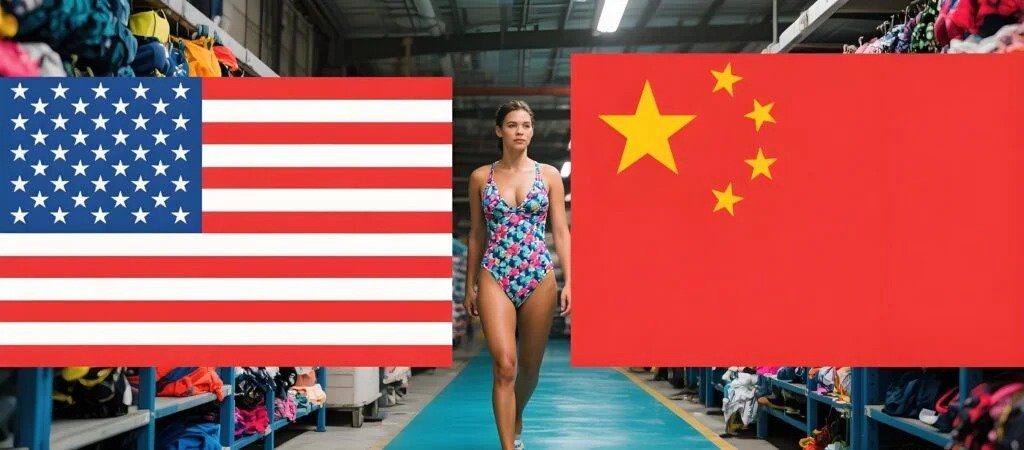
Model walks through factory aisle wearing colorful floral one-piece swimwear, flanked by U.S. and Chinese flags, showcasing international swimwear production.

The Core Financial Mechanics: Tariffs and Your Declared Value

Import duties are calculated as a percentage of the goods’ declared customs value. This is the pivotal figure. In a traditional supply chain, this value includes not only the factory’s manufacturing cost but also the profit margins of every intermediary. The tariff is then applied to this inflated total.

Consider a swimsuit with a factory FOB (Free On Board) cost of $10.

  • Traditional Sourcing (via Agent/Trading Company): The agent buys at $10, adds their margin and operational costs, and sells to you at $20. The 25% tariff is levied on $20, adding $5. Your landed cost per unit is $25.
  • Direct Sourcing from Factory: You purchase directly from the manufacturer at the FOB price of $10. The 25% tariff is applied to $10, adding $2.50. Your landed cost is $12.50.

By sourcing directly from the factory, you achieve a dual saving: you eliminate the intermediary’s markup, and you ensure the tariff is calculated on the lowest possible base price. In this example, direct sourcing cuts the unit cost by 50%. For volume orders, this arithmetic translates into decisive competitive advantage and improved profit margins.

Beyond the Tariff: Holistic Cost Optimization in Direct Partnerships

While tariff savings are significant, a direct relationship with your swimwear factory unlocks a broader spectrum of cost controls and efficiencies that compound over the long term.

Eliminating Communication Costs and Errors

Every layer between you and the production floor introduces latency and risk. Communicating design specs, fabric approvals, and fit revisions through a third party increases the chance of costly misinterpretation. A miscommunicated Pantone shade or an incorrect measurement can result in entire production runs being rejected.

Direct engagement with the factory’s technical and production teams allows for real-time clarification. You can discuss material substitutions for cost or performance, approve prototypes with direct feedback, and ensure quality standards are understood at the source. This proactive oversight prevents expensive mistakes before they happen, saving both time and money on rework, air freight for urgent replacements, or chargebacks from retailers.

Strategic Control Over Materials and Trims

Agents often work with a pre-selected roster of material suppliers, which may not offer the best value or innovation for your specific needs. When you work directly with a factory, you gain visibility into their full supply network.

This allows for collaborative value engineering. You can work with the factory’s sourcing team to:

  • Identify equivalent quality fabrics at a lower cost per meter.
  • Source trims (elastics, hooks, rings) in larger consolidated volumes for better pricing.
  • Explore new, cost-effective fabric blends or recycled material options that align with market trends and sustainability goals.
  • Lock in material prices for future seasons based on projected volumes, providing cost certainty.

This level of control directly impacts your Cost of Goods Sold (COGS) and product quality.

Operational Flexibility and MOQ Advantages

Trading companies aggregate orders from multiple clients to meet a factory’s high Minimum Order Quantities (MOQs). This model offers you little flexibility. When you partner directly with a factory, you negotiate MOQs based on your mutual relationship and order history.

Established direct partners often benefit from:

  • Lower per-style MOQs, enabling smaller, more frequent test runs for new designs.
  • Greater flexibility in production scheduling, allowing you to align manufacturing with your sales cycle and inventory needs more precisely.
  • The ability to combine styles or colors within a single production run to meet overall volume commitments, reducing the risk of dead stock.

This flexibility reduces capital tied up in inventory and allows for a more responsive, demand-driven supply chain.

Evaluating a Factory’s Suitability for Direct Export

Not every swimwear factory is equipped for a successful direct export partnership. You must assess capabilities beyond basic manufacturing. Key evaluation criteria include:

  • Export Documentation & Compliance: Can they professionally handle all commercial invoices, packing lists, and certificates of origin? Do they understand labeling requirements for your target market (e.g., FTC care labels in the US)?
  • English-Proficient Communication: Is there a dedicated account or project manager who can communicate clearly via email and video call? This is non-negotiable for managing technical details.
  • Quality Control Infrastructure: Do they have a documented QC process with in-line and final inspections? Will they provide pre-shipment inspection reports or photos?
  • Financial and Operational Transparency: Are they willing to provide detailed cost breakdowns? Is their business license and export license verifiable?
  • Experience with Your Market: Have they previously shipped directly to your country or region? This experience is invaluable for navigating customs procedures.

A factory that scores well on these points is structured to be a true partner, not just a supplier.

A Practical Roadmap for Transitioning to Direct Sourcing

Shifting from an agent-based model to a direct factory relationship requires careful planning. A phased approach minimizes risk.

  1. Initial Qualification & Sampling: Identify 2-3 potential factories. Start with a small sampling order to evaluate their responsiveness, sample quality, and communication. Use this phase to assess the points listed above.
  2. Pilot Production Run: Place a small but commercial-scale order for a best-selling or new style. This tests their production consistency, timeline adherence, and logistics handling. It’s a low-risk investment to validate the partnership.
  3. Establish Clear Protocols: With a successful pilot, formalize working procedures. Document expectations for communication frequency, payment terms (e.g., 30% deposit, 70% against copy of Bill of Lading), quality inspection standards, and how change orders are handled.
  4. Gradual Volume Shift: Begin moving a larger percentage of your total sourcing volume to the direct partner over subsequent seasons. This builds trust and gives you leverage for better terms.

Managing Logistics and Compliance Directly

When you buy direct, you take on more responsibility for logistics, but you also gain control and potential savings. You have two primary options:

  • Factory-Arranged Shipping (FOB): The factory delivers the goods to the port and loads them onto the vessel you designate. They handle export clearance from China. You appoint your own freight forwarder to manage the ocean/air freight, insurance, and US customs clearance. This is the most common and recommended model for direct importers, as it gives you control over the main leg of shipping and your relationship with a US-based customs broker.
  • Door-to-Door (DDP): The factory or their nominated agent manages the entire process to your warehouse. While simpler, this often comes at a premium and reduces your visibility and control over freight costs and customs brokerage.

Critical Compliance Step: You must engage a licensed US customs broker. They will classify your swimwear under the correct Harmonized Tariff Schedule (HTS) code, ensure proper country-of-origin marking, and file the necessary entries with Customs and Border Protection (CBP). A good broker is essential for smooth clearance and avoiding penalties.

Building Long-Term Strategic Value

The benefits of a direct factory partnership extend far beyond the initial cost reduction on your import invoice. This model builds strategic value:

  • Supply Chain Resilience: A direct line to production provides real-time visibility into capacity, potential delays, or material shortages, allowing for proactive contingency planning.
  • Faster Time-to-Market: Streamlined communication and approval cycles can shorten lead times by weeks, enabling you to react faster to trends or replenish best-sellers.
  • Collaborative Innovation: Over time, you can collaborate with the factory’s R&D team on exclusive fabric developments, construction techniques, or sustainable initiatives, creating products your competitors cannot easily replicate.
  • Predictable Costing: With transparent cost structures, you can forecast your COGS more accurately for future seasons, improving financial planning and pricing strategies.

Transitioning to direct sourcing from a Chinese swimwear manufacturer is a strategic operational shift. It requires upfront due diligence and a willingness to manage more of the import process. However, the financial payoff—a direct reduction in both intermediary margins and the base value subject to US-China tariffs—is substantial. By following a structured approach to factory evaluation and relationship building, you can secure not just lower costs, but a more agile, transparent, and competitive supply chain for the long term.