
A DD cup is not a scaled-up B cup
A swimsuit that fits well in a B cup can pass its first fitting and still fail in DD. The cup is larger, so the pattern is graded up, the straps are lengthened a little, and the sample looks reasonable on a form. Then someone moves in it. The band rides up, the cup gapes at the top, and the straps leave marks.
The cup volume is rarely the whole problem. Support comes from the system around it: the underband, the cup seams, where the straps attach and the hardware. A DD is also a relationship between underbust and bust. A 34DD and a 38DD describe two different garments even though the label looks the same.
A cup extension is therefore a construction decision. It is also one that is easy to postpone until the first sample, when the pattern has already been cut.
What changes when the cup goes up
Where a brand uses bra sizing, DD usually means a five-inch difference between the underbust and the full bust. The number in front of it is the band, and that number changes the volume behind the same letters. A 34DD holds less than a 38DD. In volume, a 34DD sits closer to a 36D or a 32E.
Copying the B cup block and adding width to the cup rarely works, because the added volume has to be carried. If the underband is still built like a light support style, the extra weight goes to the straps and the wearer’s shoulders. The band can look fine on a form. The form does not move.
What matters is where the load goes. The band, the cup seams, the strap and the hardware each need a decision, and none of them can be inherited from the smaller size without review.
The underband has to do most of the work
In a supportive top, the band should sit firmly around the ribcage and stay level when the wearer raises her arms. If it rides up at the back, the cup tips forward and the straps take over. Tightening the straps hides the symptom and creates a new problem at the shoulders.
Elastic width, elongation and recovery are the first values to settle. A wider band spreads pressure over more of the ribcage, which matters when the cup is heavy. A firmer elastic keeps the band in place, though too firm a band is uncomfortable and can restrict breathing. Recovery matters as much as stretch. An elastic that stretches to the right number but does not return will loosen after a few swims. The swimwear elastic specifications post covers how to write those values.
The attachment method also matters. A turned and stitched channel holds the elastic differently from a direct stitched edge, and the seam allowance can add bulk under the arm. Ask the sample room to show the band construction, not only the measurement.
Cup seams, moulding and lining
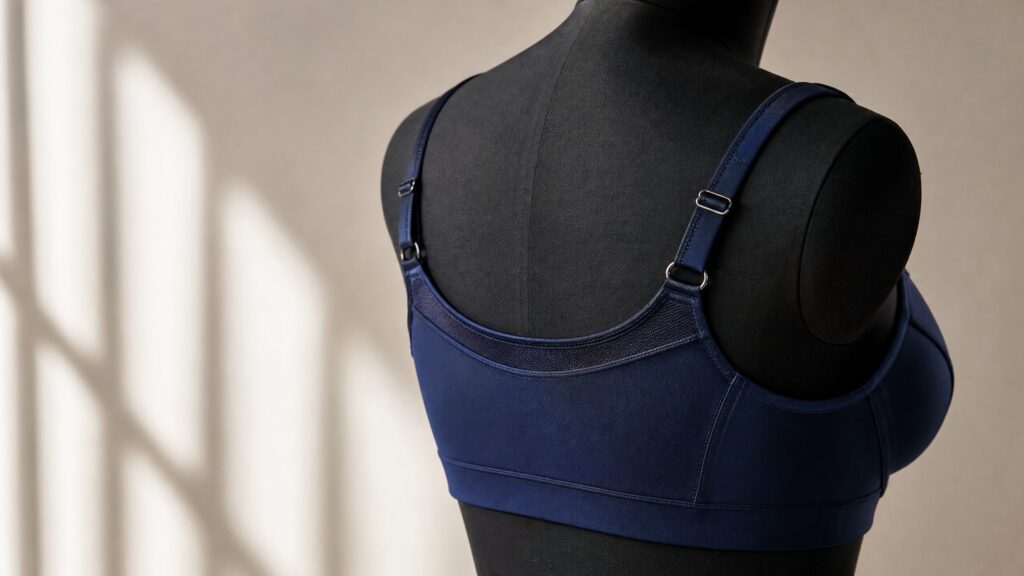
A cut and sewn cup shapes the bust with seams. Two or three panels can create depth and lift, and the seam placement decides where the shape sits. On a larger cup, a single shallow panel often cannot hold the volume without collapsing at the apex.
Moulded cups are an option, but the size range is limited and the shape is fixed by the mould. If a moulded cup is available in DD, check the cup depth and apex position, not the diameter alone. A cup that is wide but shallow will gap at the top and compress at the base.
Lining belongs in the same conversation. A stable lining or a panel of power mesh through the front and wing can add structure, but it also changes stretch, drying time and hand feel. Test the lined cup for recovery after wear, not only for opacity.
A removable pad is a separate component. It can improve coverage and shape, but it does not carry the cup. The choice between removable and fixed swimsuit bra pads should follow the construction decision, not replace it.
Wire is another option, not a default. A wire can add support, but it needs a secure casing, a suitable length and a coating that survives chlorine and salt water. Many swimwear brands choose a wire-free construction for comfort and call it a design choice. That is fine, as long as the band and cup are built to carry the load without one.
Straps and hardware take the remaining load
A narrow strap on a DD top concentrates pressure on a small area. Wider straps spread it, but they also need adjusters and rings that match the width and the load. A slider sized for a narrow strap is not interchangeable with one sized for a wide strap.
Hardware is a common weak point because it is chosen late. Check the ring and slider for strength, edge finish and corrosion resistance. A plated metal part that looks good in the sample can pit after chlorine exposure. A plastic part can flex or crack under a heavy cup. The material is less important than the rating and the finish.
Stitch details deserve a place in the review as well. Bartacks at the strap junction, a suitable thread and a consistent seam allowance affect how long the top holds its shape. They are small lines in the tech pack.
Grade the band and the cup together
A grade rule that adds the same increment to every size will drift on a DD extension. The underbust, cup width, cup depth, apex position, wing height and strap length may each need a different change. If only the bust circumference moves, the cup gets wider without getting deeper, and the band stays too loose for the larger volume.
It also helps to decide which sizes you are actually selling. A DD on a 32 band and a DD on a 40 band are not the same fit problem. Some brands carry the full band range in DD. Others start at a mid band and grade up. Either choice is workable if the sample plan reflects it. The swimwear size grading review explains how to check the resulting measurements.
The standard two-sample review is still useful, but the pair should change. For a cup extension, the most informative samples are usually the smallest band at DD and the largest band at DD. Testing a B cup against a DD cup on the same band shows the cup change. Testing the two band extremes at DD shows whether the support system survives the range. If the budget only covers one pair, this pair tells you more than a B cup and a DD cup on the base band.
Run the fit review as a load test
A fit session that only asks “how does it feel” produces opinions. Ask where the garment moves instead. The answer is often specific: the back band lifts when the arms go overhead, the left cup gaps at the top edge, the strap digs in above the shoulder blade.
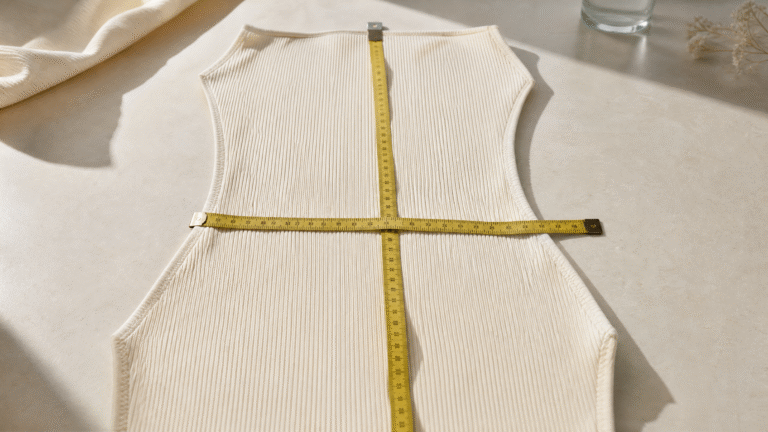
Measure the fit model at the underbust, full bust and torso, and record the cup size she normally wears. Then put the sample through movement: arms overhead, reach forward, twist, sit, bend and swim if possible. Watch the band height at the center front and center back. Look for cup gaping at the top edge, spillage at the side, wire pressure and strap dig.
Record each observation against a named point on the garment. “The band rides up at the back left” is actionable. “Feels tight” is not. Photograph the front, back and side before and after movement, and keep the comments with the sample number. A fit review that produces a clear correction list is worth more than a session that ends with a general approval.
What belongs in the tech pack
Before the sample room starts, the tech pack should state the cup construction, seam placement, underband elastic width and recovery, band height, strap width, hardware specification, lining and the grade rule for the band and cup. It should also name the base size, the fit model measurements and the criteria for approval.
When one of these is missing, the sample room usually falls back to the B cup block. That default is reasonable for a B cup and wrong for a DD. The omission tends to surface later, as a second sample round or a rushed revision.
Extending a style into DD is a reasonable move for many brands. The work is in deciding what the larger cup needs to carry, then testing those decisions on the bands where they are most likely to fail.
If a cup extension is on the table, the current tech pack and size range are enough to start. The swimwear sampling process can quote the two samples that test the support system, and the OEM swimwear manufacturing page explains how a full custom style moves from approved sample to bulk.