
The LYCRA Company’s renewable fiber and spandex recycling: what swimwear sourcing teams should take from Textile Exchange 2026
The LYCRA Company said it will showcase Renewable LYCRA® fiber and its textile-to-textile recycling work at the Textile Exchange Conference 2026, held October 12-16 at the Vancouver Convention Centre in Vancouver, Canada. The announcement came through a Business Wire press release carried by the Financial Post. For swimwear brands and sourcing teams, it is not a product launch. It is a manufacturer saying where it is putting development money.
The claims are specific enough to check and narrow enough that they need caution. Below: what was claimed, what it could mean for swimwear construction, cost and collection planning, and what to ask a mill before any sustainable-stretch language reaches a line sheet.
What the company said
Renewable LYCRA® fiber is made with 70% plant-based content. U.S.-grown dent corn is a key feedstock, with the corn sourced largely from Iowa. According to the release, the fiber replaces a significant portion of the petroleum-derived inputs traditionally used to make spandex and is now produced at commercial scale. The company cites a third-party-reviewed life cycle assessment showing a carbon footprint reduction of up to 45% while maintaining equivalent stretch and recovery. The release marks that figure with an asterisk but does not reproduce the assumptions behind it.
On circularity, the company says it has worked with textile recyclers worldwide to build and refine systems that separate spandex from companion yarns such as nylon and polyester from pre-consumer textile waste, then spin that spandex back into new fiber. It describes the outcome as a pilot-stage spandex recycling system. The next step, according to the company, is scaling the infrastructure needed to produce LYCRA® fiber with recycled content. Its product sustainability lead framed the conference message around bringing recycled and renewable materials to commercial scale. The team will be at booth #18 to talk with brands, mills and other stakeholders.
Two caveats matter from the start. This is a manufacturer’s press release, not independent reporting. None of the claims are tied to swimwear specifically.
Why elastane decides swimwear quality
In a swim knit, spandex is the smallest share of the fabric by weight and the largest single driver of how the garment behaves. Typical constructions sit around 15-20% elastane content. At Hongxiu, the standard options are nylon/spandex at 82/18 for solid colors and polyester/spandex at 85/15 for prints, both around 200 GSM with matte and shiny finishes. Swap the elastane and you change fit memory, recovery after repeated stretch, chlorine and saltwater durability, print behavior on the fabric, and the fiber content line on the care label.
That is why a renewable elastane matters more to swimwear than a renewable lining or trim would, and why it has to be validated in swim conditions rather than in general apparel. The release states equivalent stretch and recovery for the fiber generally. It does not state that the fiber has been tested in a swim knit, in chlorinated pools, in saltwater, or under prolonged UV exposure. Those are different questions with different test protocols. No data is provided here.
A second bio-based elastane move
This is the second bio-based spandex story to reach swimwear buyers in a short window. Hyosung TNC used the Global Fashion Summit 2026 to set out a bio-spandex platform. Now the market’s best-known spandex brand is presenting a plant-based fiber at commercial scale plus a recycling roadmap. Two fiber producers moving in the same direction changes the question. It is no longer whether bio-based elastane will exist, but who can supply it, in which knit constructions, at what price, and with what evidence. Treat both announcements the same way: as supplier input that still needs third-party validation at the garment level.
Recycled spandex is a watch item, not a sourcing option
The recycling work described is pilot-stage and starts from pre-consumer textile waste. Spandex is separated from companion yarns including nylon and polyester before being spun back into new spandex. There is no reported commercial recycled-content spandex supply, and no cost, minimum order, lead time, capacity or quality data. Post-consumer swimwear would be a harder feedstock still, because it combines degraded elastane with linings, elastics, cups, trims and mixed fiber blends. Swimwear teams should track this as an emerging technology, not plan a 2027 line around it. The practical move is a watch item with a named internal owner, not a sourcing decision.
Labels and claims
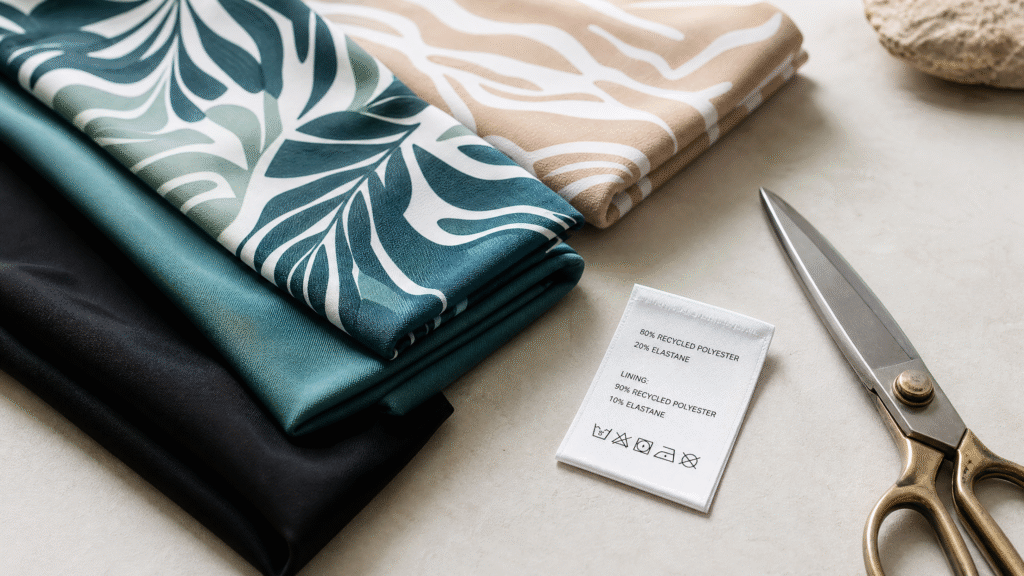
Any change to the elastane changes the bill of materials. The bill of materials drives the fiber content statement, the country-of-origin statement and the care instructions. Getting that wrong is a shipment-holding error, not a marketing nuance. Our guide to swimwear care and content labels covers what to lock before bulk, and it applies here. A supplier’s trade name is not the same as the generic fiber name a label requires. Recycled or renewable content usually needs documentation before it can be claimed. Ask for the correct labeling language in writing before a sample is approved, and do not let a claim outrun the paperwork.
Questions for your mill or fiber supplier
- Is the renewable fiber available in the denier, yarn count and knit constructions your swim styles actually use, and in the same color and print programs?
- What exactly does the life cycle assessment cover, which stages are excluded, and who performed the third-party review?
- What swim-specific performance data exists for chlorine, saltwater, UV exposure and recovery after repeated stretch in your fabric?
- What is the price delta against conventional elastane, plus the minimum order, lead time and supply continuity behind a corn-based feedstock?
- Which certifications apply, and what fiber naming or environmental claim rules apply in each market you sell into?
- Is any recycled-content spandex commercially available yet, at what scale, and from which waste stream?
Planning the 2027 season
A two-track approach fits the current evidence. Keep the core collection on proven elastane so fit, margin and delivery stay predictable. Pilot renewable elastane on a small capsule where a price delta and a new fiber can be absorbed and measured. Keep an evidence file per fiber: supplier declarations, test reports, label wording, LCA scope. Broader cost pressure in the synthetic fiber chain makes this discipline more valuable, not less, as our analysis of synthetic fiber market growth sets out. Avoid pre-announcing a fiber switch in consumer marketing before commercial availability and labeling are confirmed.
Limitations
The claims are company-provided. Renewable LYCRA® fiber is described as commercial-scale generally, not as commercially used in swimwear. The recycling system is pilot-stage with unproven cost, quality and availability at scale. The 45% carbon figure depends on an assessment whose data and caveats are not disclosed. No swimwear testing, pricing, minimum order, lead time, certification or compliance detail is reported. Nothing here supports a sourcing commitment on its own. Hongxiu will keep tracking elastane and circularity developments on our industry news page as more verifiable data emerges.