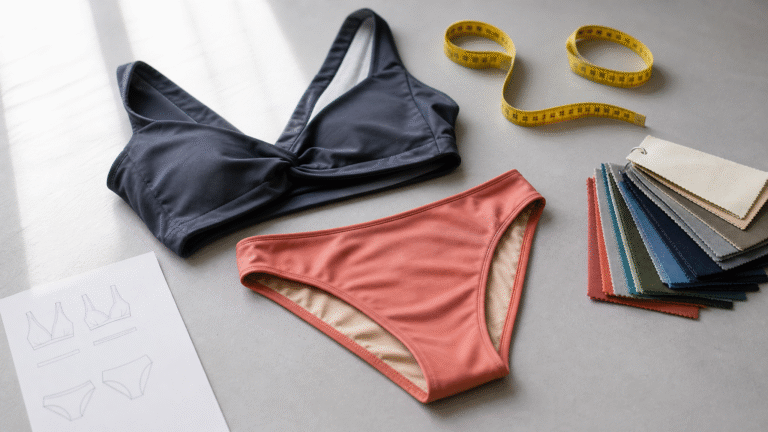

Getting swimwear care and content labels right before bulk production
A swimwear label looks like a print detail. It is really a summary of the bill of materials. Fiber percentages, care instructions, and country of origin all have to describe the garment that actually ships, and they are often finalized while the shell fabric, lining, and trims are already fixed. When one of those inputs changes late, the label becomes the single item on the order that no longer matches.
The mismatch is easy to miss before shipping. A hangtag can be reprinted in a few days. A sewn-in label cannot be corrected without opening cartons, and an import marking error can hold the shipment and add duty. Label data belongs in the production schedule, not in the last week before delivery.
What follows is what US and EU rules require on a swimwear care and content label, which fields move most often on swim orders, and how to lock the data before bulk production starts.
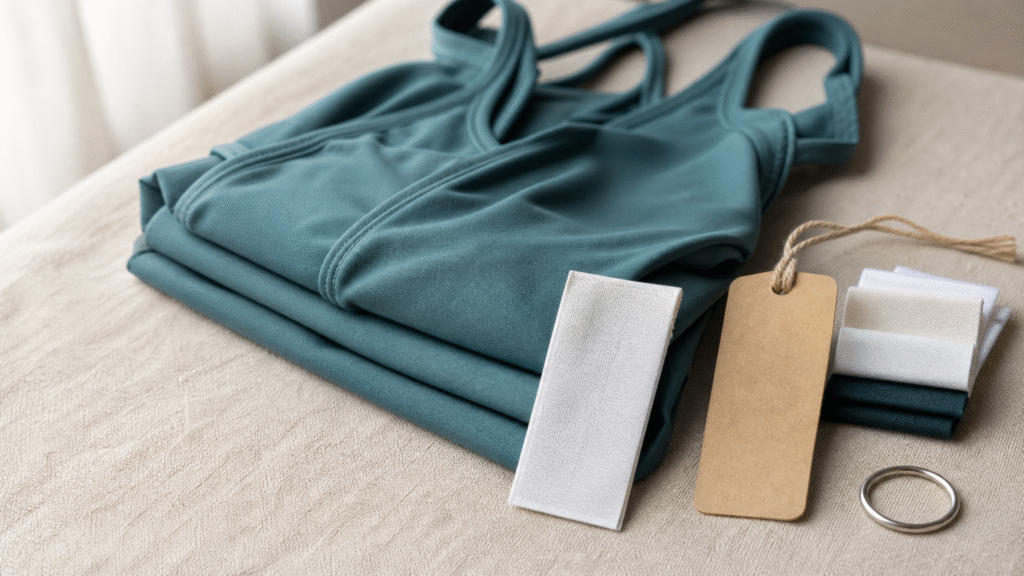
Why label problems surface after production
Most label errors are not printing errors. They come from a change that was correct in itself. A lining is switched to a different tricot, and the fiber percentages on the label are now wrong. A pad is added to the cup, and the care instruction no longer covers the new component. A print is moved to a different base cloth, and the fiber line and the origin change with it.
The label is also the one document that follows the garment past the factory gate. Customs reads it at the border. A retail compliance team reads it at receiving. A customer reads it before the first wash. Each of those readers compares the label with the garment, and each can reject an order for a mismatch that production already accepted.
What US rules require on a swimwear care and content label
For swimwear sold in the United States, three separate requirements usually land on the same small piece of fabric.
The care labeling rule (16 CFR Part 423) requires regular care instructions on textile wearing apparel, which includes swimwear. The label has to be permanently attached and legible for the useful life of the garment. It must give either a washing or a dry cleaning instruction, with the method and water temperature unless hot water is safe, and the drying method and temperature unless high heat is safe. Ironing is required only when the garment normally needs it. If bleach would harm the item, the label has to say so, and if a reasonably expected procedure would damage the garment, the label has to warn against it. When folding or packaging hides the label at sale, the same care information must also appear on the package or a hangtag.
Fiber content comes from the Textile Fiber Products Identification Act (16 CFR Part 303). Fibers at or above 5 percent by weight are named with their generic name and percentage, listed in order of predominance. Fibers below 5 percent are grouped as “other fiber” unless a fiber has a clearly established functional significance, as elastane does in a stretch knit. The label also has to identify the manufacturer or marketer by name or by an FTC Registered Identification Number, and it has to state the country of origin. For a garment with a neck, the country of origin must appear on the front of a label at or near the center neck.
Country of origin marking for imports is a separate customs rule (19 CFR Part 134). Imported articles must be marked legibly, indelibly, and permanently with the English country name. A securely attached tag can work, but it has to survive normal distribution and stay with the garment until the final purchaser. Goods that are not properly marked can face an additional 10 percent ad valorem duty and a redelivery demand.
In practice, most swimwear ends up with one sewn-in label near the neck that carries the fiber content, the identity line, the country of origin, and the care instructions. A hangtag is added when the sewn label is not visible at sale, or when the brand wants to repeat the same information in its own design.
What the EU fiber label requires
In the European Union, Regulation (EU) No 1007/2011 governs fiber composition. It works from a fixed list of fiber names, so the label has to use “elastane” and not the US generic name “spandex.” A blend lists every constituent fiber with its percentage by weight in descending order, and a product can be described as 100 percent or pure only within a small allowance for extraneous fibers. The label has to be durable, easily legible, visible, and securely attached, and it has to be in the official language of the member state where the garment is sold.
Care labeling is not harmonized across the EU. Member states and voluntary systems handle it, and the symbol set most buyers use comes from GINETEX and ISO 3758. An EU order therefore usually needs a fiber composition label that satisfies 1007/2011 and a care label that follows the symbols the destination market expects. Both have to agree with the garment that ships.
The swimwear fields that change most often
Four fields cause most of the trouble, because they move with the fabric or the trim rather than with the print file.
Elastane percentage is the first. A stretch swim knit is commonly quoted as a polyamide and elastane blend, and the elastane share can move when the mill changes the base cloth or the buyer asks for a firmer hand. The fiber line has to follow the final mill specification, not the counter sample’s.
Lining fiber is the second. When the lining uses a different fiber from the shell, it has to be disclosed. A shell listed as polyamide and elastane with a polyester lining is a different fiber statement from the same shell with a polyamide lining.
Trim composition is the third. A metal slider or ring is not a textile fiber, but a coated or fabric-covered trim can change the fiber statement, and added components can change the care instruction.
The care basis is the fourth. Chlorine, salt water, and sunscreen are not named in either the US or the EU fiber rules. If the care instruction you want to print assumes a wash method that would harm the garment, the warning needs a reasonable basis, and that is a formulation question rather than a marketing one.
Sewn-in label, hangtag, and polybag: who controls what
The sewn-in label is the legal document. The hangtag and the polybag are branding and logistics, and they can say more than the label as long as they do not contradict it. A hangtag that does not carry the full fiber content has to point the reader to the label and say so.
This is where the difference between private label swimwear and a full custom program becomes visible in the paperwork. On a private label order, the garment keeps the factory’s generic sewn-in label and the buyer’s brand goes onto the trims: hangtags, polybags, hygienic liners, and stickers. If the buyer needs their own sewn-in care and content label, the label on the garment itself has to change, and that is a development step rather than a print add-on. OEM and ODM swimwear manufacturing covers that path, including woven, heat transfer, and TPU labels made to the buyer’s artwork.
Locking label data before bulk
The clean way to avoid a late label change is to treat the label data as part of the approved bill of materials. The fiber line, the care text, the origin, and the identity line should be attached to the fabric and trim choices, so that any substitution automatically reopens the label for review.
That discipline is the same one behind production change control after sample approval. If a mill lot, a lining, or a pad changes, the label is on the list of documents that have to be rechecked before the order is released. It also helps to place the label order at the same time as the swimwear fabric and trim sourcing, because label lead time and trim lead time interact when the artwork depends on the final fiber call.
Reversible and printed styles
Two swimwear constructions deserve extra attention. On a printed garment, the base cloth behind the print determines the fiber line, and a print that moves to a different base changes the label even when the artwork does not. On a reversible garment, both faces are visible in wear, so a label sewn into one side can sit against the skin on the other side, and the placement has to be chosen rather than inherited. The US care rule has a narrow exemption for totally reversible, pocketless items, so check the construction against the exemption before relying on it. Reversible swimwear production covers the placement and edge questions in more detail.
A pre-shipment label check
- Read the sewn-in label against the final bill of materials: fiber names, percentages, and order.
- Check that the country of origin on the label matches the customs marking and the shipping documents.
- Confirm the care text covers the fabric, the lining, and any padded or metal component.
- Compare the hangtag and the polybag with the sewn-in label, and make sure nothing contradicts the legal line.
- Photograph the finished label on a sealed garment before the cartons are closed.
What to do next
Label data is easier to control when it is treated as a production input. Decide the fiber line, the care instruction, and the origin at the same time you approve the fabric and the lining, and put the sewn-in label into the change control list next to the shell. If your range spans private label and custom development, start with the private label scope for trims and move to the OEM path only when the garment label itself has to carry your own artwork.
If you want the label set up with the order rather than after it, send the tech pack and the destination market to our team and we will confirm what the sewn-in label has to carry for that market.