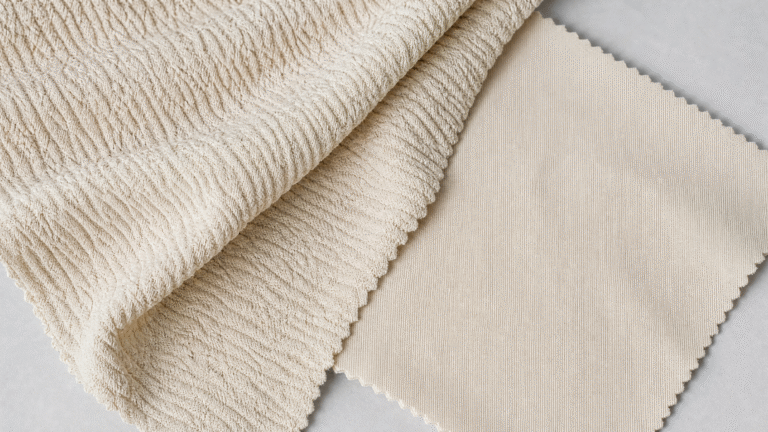

MIT’s melt-respin stretch yarn: a watch item for swimwear sourcing teams
Swimwear’s defining performance fiber carries an end-of-life problem the category has never solved. Elastane delivers the stretch a swimsuit needs, and the same elastane is what makes the garment hard to recycle once it is blended into a polyester or nylon knit. A research team at MIT has now reported a stretch yarn designed to sidestep that dead end: a thermoplastic yarn made from two variations of polyethylene that, per the reporting, can be melted and respun without separating anything first. MIT Technology Review published the story on October 20, 2026, written by Jennifer Chu, in the magazine’s November/December 2026 issue under MIT Alumni News.
What the report actually says
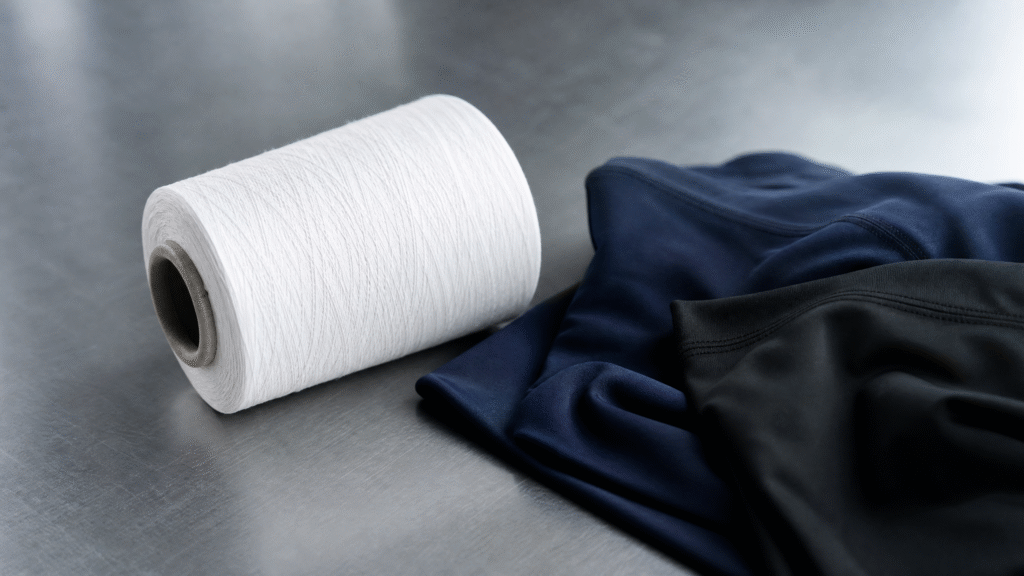
The yarn is built from two variations of polyethylene, the polymer family behind milk jugs and grocery bags, and is designed to mimic the properties of conventional elastic yarns that pair spandex with polyester or nylon. Because both components sit in the same chemical family, the yarn can be melted as is, without the fiber-separation step the article describes as impractical for today’s stretch blends. Svetlana Boriskina, a research scientist in MIT’s Department of Mechanical Engineering, led the work.
The durability figure is a recycling figure, not a wear figure: after 10 cycles of melting and respinning, the yarn reportedly stayed as strong and flexible as conventional thread. The team says the material can now be knitted and woven, and calls that the next stage. The long-term ambition is a polyethylene garment that could be dropped in a collection bin and routed back into new yarn. The article also cites a waste figure: the average American discards roughly 81 pounds of clothing a year, with few recycling routes available.
The gaps a swimwear team should see
For a swimwear team, the gaps matter more than the claim. The article never mentions swimwear, swim fabrics, or any brand, mill or garment program. The swimwear link is inferred from the elastane-replacement premise. Specifically, the source provides none of the following:
- Chlorine or pool-chemical resistance, saltwater exposure, UV stability, wet-state stretch and recovery, snagging, pilling or colorfastness data.
- Fabric-level testing of any kind, or dyeing and finishing trial results.
- A spinning partner, knitting partner, production volume, cost per kilo or commercial timeline.
- Evidence that “can be knitted and woven” is a demonstrated outcome, because the researchers present it as the next stage.
Two structural caveats sit on top of that list. The 10-cycle result applies to the yarn in isolation; a finished swimsuit contains linings, cups, power-mesh panels, trims, hardware and prints, any of which could contaminate a mono-material recycling stream. And this is lab-stage work reported in the magazine’s MIT Alumni News section, not independent industrial testing. The claims should be treated as preliminary until peer-reviewed detail or third-party validation appears.
Why elastane is the hard part
Most swimwear is a stretch knit built on one of two bases, and both embed the same recycling obstacle. Our swimwear fabric guide describes the standard pair: nylon/spandex at roughly 82/18 and about 200 GSM for a soft hand feel and solid colors, and polyester/spandex at roughly 85/15 for prints plus better chlorine and sunlight resistance. In each case the elastane content is small by weight but decisive by function, and decisive for end of life too, because separating it from the base fiber is the step that makes the blend uneconomic to recycle. That is the step the MIT yarn is designed to eliminate by staying inside one chemical family.
The signal is worth logging even though it is early. A mono-material route to stretch knits would touch fiber sourcing strategy, recycled-content and circularity claims, and design-for-disassembly choices: whether a suit is built to be taken apart or built to be recycled whole. It would not, on its own, solve swimwear’s other end-of-life contaminants: the lining, the pads, the metal sliders, the heat-transfer branding.
Questions to put to fiber suppliers
The practical use of this story today is as a briefing document, not a spec sheet. If a supplier eventually presents a polyethylene-based stretch yarn, these are the questions a swimwear team should already have written down:
- Chlorine and pool chemistry. Chlorinated pool water is a demanding environment for any swimsuit; polyester/spandex already has better chlorine resistance than nylon/spandex, and any replacement fiber must be measured on the same basis.
- Wet performance. Stretch and recovery measured wet, not dry, plus retraction after repeated immersion.
- Heat behavior. Polyethylene’s softening range is low relative to the nylon and polyester it would replace, which raises a question for swimwear assembly. Heat, ultrasonic bonding and adhesive film are all used in swimwear construction, as our guide to seamless swimwear production explains. A fiber that cannot survive those processes is not a swimwear fiber.
- Surface and hand. Hand feel, printability and print adhesion on a polyethylene surface, plus resistance to sunscreen and chlorinated water.
- Contamination tolerance. Whether melt-recycling survives linings, cups, trims and prints in the same stream.
- Commercial reality. Cost per kilo, minimum spinning volumes and a dated scale-up path.
How it compares with other stretch-fiber signals
This is one of several early-horizon moves on the same problem. Swimwear teams should track them as a group. The LYCRA Company’s renewable fiber and pilot-stage spandex recycling plans address the incumbent fiber from inside the existing supply chain. Hyosung TNC’s bio-spandex platform attacks the feedstock side at industrial scale. The MIT yarn proposes something structurally different: abandon the blend entirely so that melting is enough. None of the three is a switch you can flip for a 2027 range, but together they show the directions now competing for attention.
What swimwear teams should do now
Nothing in the current range should change. There is no swimwear performance evidence, no fabric trial, no cost and no timeline, so no sourcing or specification decision can be made from this article. What is reasonable and cheap is housekeeping: log the technology in the materials roadmap under early-horizon watch items; keep a standing supplier question on mono-material stretch options and their chlorine data; avoid any recycled-content or circularity claim that leans on lab-stage research; and continue designing for disassembly where the construction allows it, because trim and lining choices will decide whether any future mono-material suit is actually recyclable.
Brand owners should also be careful with consumer-facing language. A claim that a swimsuit is “designed for recycling” needs a collection route and a processing partner behind it. The MIT work describes an ambition, not a system.
A watch item, not a tech pack entry
A stretch yarn that survives 10 melt-respin cycles is an interesting materials result, and it aims at the exact construction, elastane blended with polyester or nylon, that dominates swimwear. But it is a technology for swimwear teams to watch, not something proven or in commercial use in swimwear. Track it, question suppliers about it, and keep it out of the tech pack until someone publishes chlorine data and a fabric trial. More signals like this land regularly in our swimwear industry news section.