
In recent years, seamless swimwear has seen steadily rising demand in the global swimwear market. From high-end European and American sports brands to emerging DTC swimwear labels, “seamless” has become a core selling point across product lines. However, for many buyers and brand owners, how exactly is “seamlessness” achieved? What are the key process differences from traditional swimwear? And which technique best suits your product positioning?
This article breaks down the two mainstream technological pathways for seamless swimwear from the ground up, helping you systematically understand the process differences you need to consider when sourcing.

What is Seamless Swimwear?
Strictly speaking, “seamless swimwear” does not mean it has no stitches at all. Rather, it refers to a production approach that significantly reduces or completely eliminates traditional sewing seams through specialized manufacturing processes, resulting in a smooth body feel, clean appearance, and the elimination of pressure marks and friction against the skin.
From a technical perspective, there are currently two main methods for achieving a “seamless” effect in the global swimwear industry: Seamless Knitting and Thermal Bonding. These two technologies operate on completely different production principles, and differ significantly in terms of applicable product types and cost structures.
Technology Route 1: Seamless Knitting (Whole-Garment Knitting)
Principle Overview
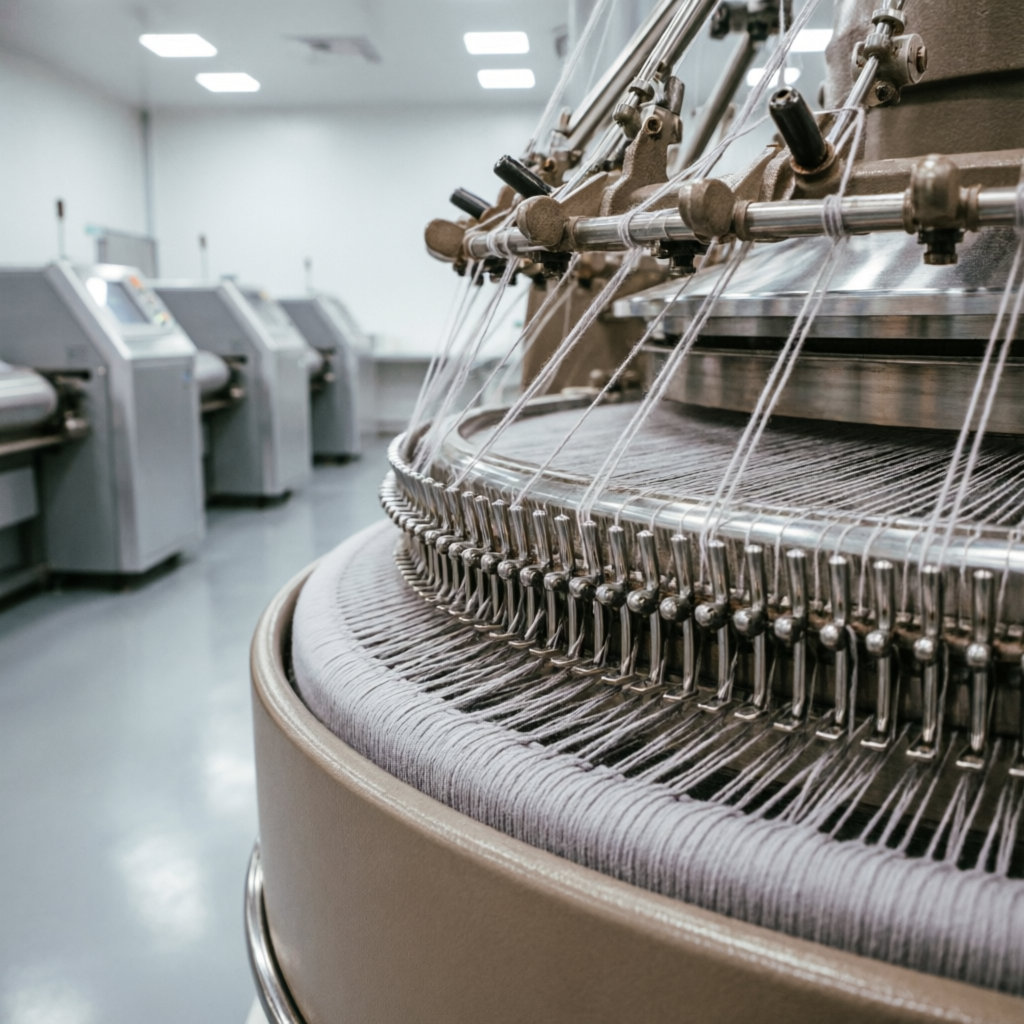
The core principle of seamless knitting is “one-piece forming” using specialized computerized circular knitting machines (representative models include Italy’s Santoni SM8 series). These machines utilize multi-feed yarn delivery systems capable of automatically changing yarn types, fabric structures, density, and patterns according to pre-programmed instructions during a single knitting process. They directly produce garment pieces—or even entire garments—with complete three-dimensional shaping.
How It Works in Detail
- Yarn selection: Seamless swimwear typically uses blended yarns of Nylon and Spandex (Lycra®). Spandex provides the elasticity essential for fit and recovery, while Nylon delivers strength and abrasion resistance. Some high-performance products also incorporate functional yarns with antibacterial, chlorine-resistant, or UPF sun-protection properties.
- Computer programming and pattern design: Before production begins, technicians convert the swimwear’s pattern data, size specifications, and jacquard designs into machine-executable programming instructions. The machine controls each knitting needle’s action to create different fabric densities across various areas—tighter structures in areas requiring more support such as the bust and hips, and lighter, more stretchable sections for the waist and abdomen.
- Integrated knitting: During operation, yarn feeds continuously into the machine while needles move up and down at high speed according to the program, knitting loop by loop. Since there is no “cutting” stage and no subsequent sewing assembly required, the finished garment panel already possesses the garment’s basic shape. Only minimal edge finishing is typically needed at areas like straps and leg openings.
Advantages of Seamless Knitting
- Zero side seams or minimal stitching: Extremely comfortable wearing experience, especially suited for high-intensity water sports.
- Reduced material waste: Traditional cut-and-sew swimwear generates approximately 15% to 20% fabric waste, while seamless knitting produces virtually none.
- High production efficiency: From yarn to finished garment piece, intermediate steps like cutting, fusing, and assembly are eliminated, shortening the production cycle.
Limitations
- Requires very high-quality yarn and precision equipment, with significant investment thresholds.
- Design freedom for patterns and structures is constrained by the machine’s needle cylinder size and needle arrangement—complex combination designs are less flexible than traditional methods.
- Strict consistency control of yarn tension, knitting speed, and other parameters is required in mass production, otherwise size deviations may occur.
Technology Route 2: Thermal Bonding (Seamless Bonding)
Principle Overview
Thermal bonding does not mean “no sewing” but rather “replacing stitches with adhesive bonding.” The principle involves using polyurethane (PU) or TPU (thermoplastic polyurethane) hot-melt adhesive films on traditional cut fabric pieces. Through high temperature and pressure, the edges of two fabric pieces are fused together, forming smooth, pinhole-free adhesive bonds with elasticity and strength.
How It Works in Detail
- Cut piece preparation: Similar to traditional swimwear, fabric is first cut into individual pattern pieces. However, unlike traditional methods, bonding technology requires wider seam allowances at connection points to ensure sufficient adhesive area.
- Adhesive film positioning: A layer of hot-melt adhesive film (typically TPU, 0.05 mm to 0.15 mm thick) is precisely placed between the edges of the fabric pieces to be joined. TPU film maintains elasticity after drying and retains strong adhesive performance even under water immersion and stretching.
- Heat pressing: The fabric pieces with adhesive film are fed into a heat press machine. Under controlled temperature (typically 150°C to 200°C, depending on fabric composition and adhesive film characteristics), pressure, and time conditions, the pieces are pressed together. Heat melts the adhesive film, which penetrates the fabric fiber gaps and forms a strong bond upon cooling.
- Reinforcement: For high-stress areas (such as strap connections or the crotch area), secondary bonding or inner reinforcement tape may be applied to enhance seam tensile strength.
Advantages of Thermal Bonding
- Smooth, non-detectable seams: No raised thread ridges like traditional sewing, providing excellent skin contact with virtually no pressure marks.
- Water penetration resistance: The hot-melt adhesive film creates a continuous sealed layer at the seams, making it difficult for water molecules to penetrate—especially important for competition and training swimwear.
- Greater design freedom: Since fabric pieces can still be freely cut and combined, thermal bonding allows for more diverse color blocking and structural designs, offering greater style variation flexibility than seamless knitting.
Limitations
- Requires extremely high-quality adhesive films and stable bonding processes. Poor bonding may lead to delamination or bubbling.
- The bonding process is semi-manual and semi-automated, resulting in slightly lower production efficiency than seamless knitting.
- For certain lightweight or high-stretch fabrics, temperature and pressure control during bonding needs to be highly precise to avoid fabric damage or shrinkage.
Sourcing Decision: How to Choose the Right Technology
As a B2B buyer, understanding the differences between these two technologies helps you more accurately match product positioning with cost budgets.
Choose Seamless Knitting When:
- Your product is positioned as high-performance athletic swimwear or body-hugging fitness swimwear.
- You emphasize a “zero friction” and “second skin” wearing experience.
- Order volumes are large enough to amortize equipment investment and programming costs.
- Designs lean toward simplicity, single colors, or basic striped jacquard patterns.
Choose Thermal Bonding When:
- Your product line features multi-color blocking and complex design elements.
- You need rich style variations while maintaining a smooth appearance.
- Order volumes range from small-to-medium to large batches with flexible arrangements.
- Water resistance and seam structural strength are priorities (e.g., surfwear, triathlon suits).
Key Quality Control Points
Regardless of which seamless technology you choose, the following quality control checkpoints deserve close attention during factory audits and product inspections:
- Color fastness and chlorine resistance: Swimwear is frequently exposed to chlorinated water or seawater. The durability of fabric and adhesive film against chlorine and fading directly impacts product lifespan.
- Elastic recovery testing: After repeated stretching, does the seamless area meet recovery standards? For thermal bonding products, the elastic recovery of the adhesive film is a critical indicator.
- Laundering durability: After multiple machine or hand wash cycles, does seamless knitting show loose threads or pilling? Does thermal bonding show edge peeling?
- Dimensional stability: Seamless knitting has strong overall stretchability due to the absence of cut seams, but density variations across different areas may cause dimensional drift. Consistent sizing across production runs requires close attention.
Conclusion
Seamless swimwear is not a single concept—it encompasses fundamentally different manufacturing logics and process systems. As a buyer, understanding the principles and differences between seamless knitting and thermal bonding helps you communicate requirements more precisely with suppliers and avoid discrepancies in samples or bulk production caused by misaligned expectations.
If you are looking for a partner with solid swimwear production experience and expertise in seamless technologies, feel free to reach out. Located in Xingcheng, Liaoning—the heart of China’s global swimwear industry cluster—Hongxiu Clothing Co., Ltd. is led by a founder with over three decades of swimwear manufacturing experience. We have mature production capabilities in both traditional sewing and seamless technologies, supporting flexible cooperation models from 50-piece quick-turn small orders to large-volume bulk shipments.