
Tony Fadell’s AI fabric inspection bet: a swimwear sourcing read
Fortune reported on 19 November 2026 that Smartex.AI is launching physical AI products for textile quality control, with Tony Fadell, the designer behind the iPod, iPhone and Nest, joining as chairman after investing roughly $10 million in the company. H&M is an investor in Smartex, and strategic H&M suppliers are among the launch customers for the new inspection hardware.
For swimwear brand owners and sourcing teams, the useful reading is limited. This is a technology to watch, not a capability you can write into a tech pack today. Fortune’s reporting contains no swimwear mill, no swimwear fabric and no swimwear brand. What it does contain is a specific argument about where fabric cost and fabric uncertainty sit inside an apparel supply chain, and that argument is worth understanding before anyone proves or disproves it on an elastane-blend swim knit.
What Fortune reported
Beyond the framing, the reported substance is a hardware company moving from monitoring to inspection:
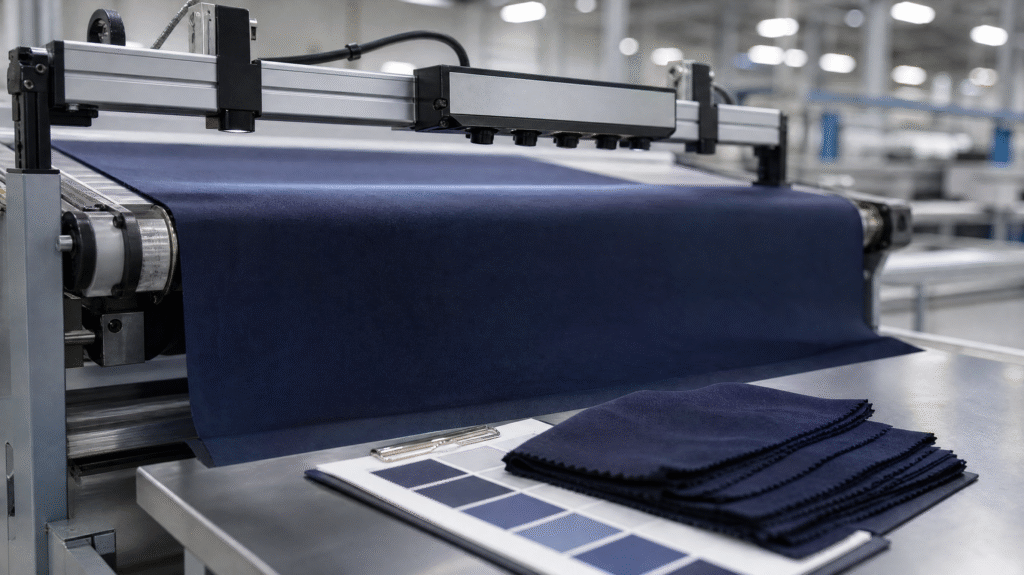
- Smartex Inspect is a camera system that attaches to existing textile machinery and watches material as it passes, claimed to run at three times the speed of a human inspector.
- Smartex IQ turns the supply-chain data generated by those systems into intelligence for brands.
- Smartex has roughly 65 employees, revenue in the low millions annually, and 800 of its older monitoring systems installed at clients in 10 countries.
- Its valuation was $55 million four years ago; CEO Max Easton declined to give a current number.
- The models are calibrated against a library of 50 billion fabric images to absorb lighting changes, line speed, color variation and each client’s own standards.
Those are reported facts. The savings numbers that follow are not, and the difference matters when you build a business case.
The cost argument
Easton’s framing to Fortune is that fabric is around 50% of an apparel company’s cost base. Because quality is inconsistent, he says, a retailer like H&M typically over-orders about 5% more fabric than it needs as insurance against some yardage being unusable. He puts the global equivalent at about 2.5 billion metres of fabric a year, or roughly $10 billion at $4 a metre, and estimates Smartex could save H&M $100 million annually by cutting that waste.
Two points of caution. First, Fortune presents the $100 million figure as Easton’s estimate for one retailer, not an audited result. Second, the mechanism matters more than the number. The claim is that a brand pays a recurring premium for not knowing whether a roll is good until it reaches the garment house. That is a risk-management cost rather than a fabric cost, and it sits alongside the supplier-concentration and lead-time pressures we examined in our analysis of H&M sourcing data and what it teaches swimwear supply chains.
Where swimwear diverges from the H&M case
A high-street jersey program and a swim program are not the same buying problem. The gaps are specific.
- Two fabrics per garment. A swimsuit usually pairs a shell with a lining, sometimes from different lots. Shade agreement between body and lining is a defect risk that a single-roll inspection pass does not settle on its own.
- Defect taxonomy is different. Fortune cites holes, needles and wrong yarn, which are generic apparel faults. Swim buyers also track barré, needle lines, lycra damage and shade variation across a set sold together.
- Inspection is not performance testing. A camera classifies what it sees on a moving roll. It says nothing about chlorine resistance, UV exposure, saltwater, stretch recovery, snagging or colorfastness, the properties that decide whether a swimsuit survives a season. Those remain bench tests on specimens.
Nothing in the Fortune report suggests Smartex has been validated on elastane-rich knits, on swim linings, or by any swimwear manufacturer. H&M’s investment, and Smartex’s wider apparel customer base, are not evidence of swim adoption.
Color consistency
Fadell’s sharpest observation to Fortune is about subjectivity: a worker with swatches judges a roll differently in the morning than on a Friday afternoon, and unlike a print there is no reference standard for what counts as acceptable quality. The point applies directly to swimwear, where core solids such as black, chocolate, ecru and optic white are reordered season after season and compared against the piece next to them on a rail.
How those solids behave depends on the fiber behind them. Our swimwear fabric guide sets out how nylon/spandex and polyester/spandex differ in hand feel, print suitability and resistance to chlorine and sunlight. Those differences change what an inspector should flag, and how much shade drift a buyer can tolerate before a reorder reads as a different product.
What an inspection pilot would have to prove
If a mill in your supply chain offers camera-based inspection, the useful posture is curiosity plus a short list of questions. Has the model been validated on the exact fabric you buy, at your GSM and elastane percentage? What is the false-positive rate, and who dispositions a flagged roll? Does it hold up at your mill’s real line speed, and does it capture shade or only physical faults? Who owns the resulting data, and does it survive a change of mill?
Before any of that, you need a standard to inspect against. Our guide to agreeing what counts as a swimwear defect before your order ships covers how to define defects, choose a sampling plan and time checks before packing. It is also the foundation for judging whether an automated system measures the same thing your AQL table does.
Three practical moves
- Write the defect standard first. Automated or human, inspection needs a written definition of major, minor and critical for swim shells, linings and trims. Without it, camera output is a second opinion.
- Measure your own over-order. The 5% figure is a general apparel benchmark, not a swimwear statistic. Track how much fabric you write off per style and per fabric lot. That number is the ceiling on what any inspection investment could return.
- Pilot on one fabric and one reorder. Run any new inspection step against a single swim fabric across two production lots so you can compare flagged defects with what your own QC finds. Our swimwear manufacturing process guide maps where fabric checks, cutting, sewing and final QC sit, so you can see where a new check would change a decision.
What is still open
Smartex’s proposition, as Fortune describes it, is a real problem statement: fabric is expensive, quality judgment is subjective, and brands pay a premium for uncertainty. That is true in swimwear too. What is not established is whether camera-based inspection performs on swim knits, whether it catches the color and stretch-related faults that ruin a swim program, or whether the savings claims survive independent measurement.
For now this is a technology to watch and, at most, to test on a single fabric lot. It is not a sourcing decision and not a substitute for the lab testing and written defect standards that already govern swim quality. The inspection layer may modernize. The specification sheet remains the document that defines quality.