
Why swimsuit straps dig in, slip, or stretch out
A strap can look correct on the sample table. The width matches the tech pack, the color is right, and the join is clean. Then the fit model lifts both arms and the slider slides half a centimeter. The cup shifts, the strap loosens, and the sample that looked finished needs another round.
The strap was not necessarily sewn badly. It was asked to carry load in a direction, and at a length, that the spec never fully described. Width, path, finished length, and recovery are the four decisions behind most strap complaints. Each one can be settled before the sample room starts cutting.
Width and path decide where the pressure goes
The same load spread across a 10 mm strap and a 20 mm strap does not feel the same on the shoulder. A narrow strap concentrates pressure into a small band of skin. On a light bikini top with a small cup, that can be a reasonable trade for a cleaner look. On a fuller cup, or a one-piece where more fabric hangs from the shoulder, it will dig in even when the length is correct.
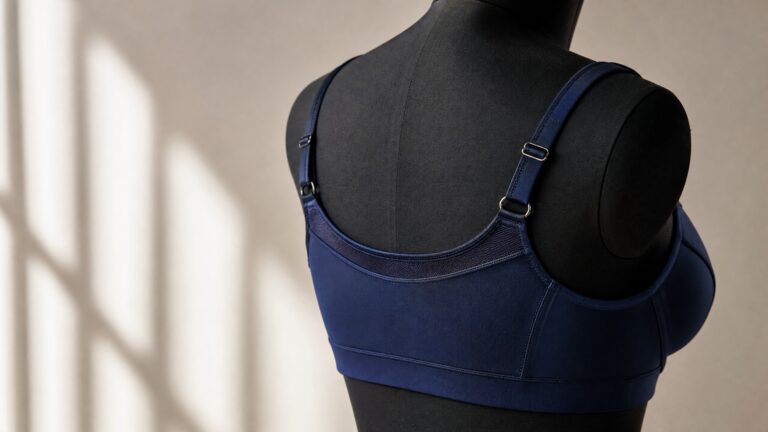
Width does not create support on its own. Most of the hold should come from the underband and the cup structure. When the band is loose, the straps take over and the wearer tightens them. The result is shoulder marks, a cup that tips forward, and a strap pulled past the range it was designed for. The DD cup construction guide walks through that load path for fuller busts.
The path changes the direction of the pull. A straight strap over the shoulder mostly holds vertical position. A halter pulls the cup up and toward the neck, which can flatter a small bust and irritate the neck on a heavier one. A cross-back spreads tension across the back. A style cannot inherit a strap from another style just because the cup size is close. The angle and the anchor points are part of the design.
Length needs a stated tension
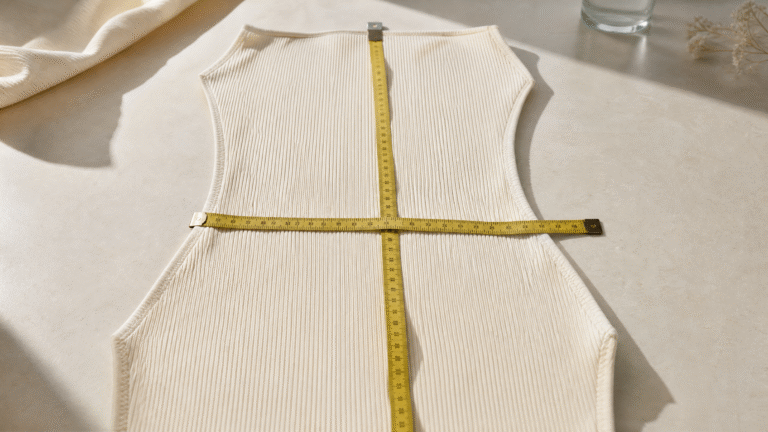
Strap length 38 cm is not a specification on its own. Is that the cut length of the elastic, the finished length after sewing, or the length of a stretched garment? Is it measured along the curve or straight between the two attachment points? Two sample rooms can make different garments from the same number.
Write the length as a finished measurement between the attachment points, taken along the strap centerline, with the strap pulled to a stated tension. Add a tolerance and say whether the measurement is taken flat or on a form. Without that method, the number cannot be checked at QC.
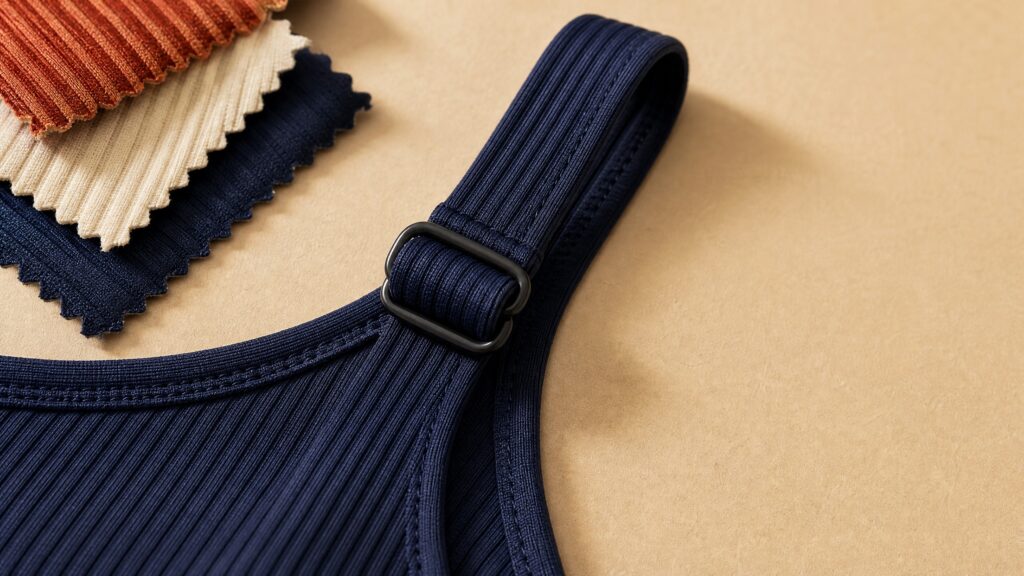
For an adjustable strap, give the shortest and longest finished settings, not only the travel of the slider. A slider that moves 6 cm is useful only if the base length puts the wearer in the middle of that range. If the base is too long, most wearers end up at the end of the adjuster, where a thin strap is most likely to bunch or slip.
Put the adjuster position in the spec too. A front slider is easy to reach and easy to see. A back slider is less visible and harder to adjust while wearing. Pick one for the style and keep it, because moving the slider later changes the finished length at every setting.
Recovery keeps the length
A strap can be cut from the shell fabric, from a dedicated elastic, or from fabric with elastic enclosed inside. The three behave differently when wet, when stretched, and after contact with chlorine, salt, and sunscreen.
Elastane loses recovery over time, and chlorine and heat speed that up. A strap can pass a stretch check in the sample room and still relax after a few swims. When it does, the cup drops, the strap loosens, and the wearer tightens the adjuster to compensate. The strap has not broken. It has stopped returning to its finished length. The swimwear elastic specification guide covers how to name the material, width, and application so this becomes testable.
A folded fabric strap with no elastic behaves differently again. It will not stretch much, which can be fine on a fixed-length style where the fit is already correct. It also will not conform to the shoulder the way an elastic strap does, and on a heavy cup it may put more load on the seam. A fabric strap with elastic enclosed inside gets some of both, with more bulk at the attachment and a longer sewing operation. Choose it because the style needs it, not because it sounds more premium.
The join takes more load than the strap
The strap itself rarely fails first. The junction between the strap and the cup, band, or ring is where repeated tension collects. If that join is a single seam with a short backstitch, it may survive a photo shoot and fail in wear. A bar tack, a box-X, or a short run of dense zigzag spreads the load over more stitches. Seam allowance matters too: too much bulk under the arm or at the cup edge creates a hard point that rubs.
Hardware adds another failure path. An adjuster or ring that is wider than the strap lets the strap twist and bunch. A rough edge abrades the fibers. A coated metal part that chips exposes an edge that can corrode. The swimwear hardware guide covers material and finish selection, but the fit between strap and component has to be checked on the actual sample. A catalog width is not a fit test.
What to put on the strap spec
For each strap, record the type and path, the material and elastic reference, the width, the finished length at a stated tension, the tolerance, the adjustment range, the adjuster position, the attachment method at both ends, the hardware reference and finish, the color, and the thread. That is enough for the sample room to build the strap and for QC to measure it.
| Field | What to write | Why it matters |
|---|---|---|
| Path | Straight, halter, cross-back, racerback | Sets the direction of pull and the pressure point |
| Material | Shell fabric, elastic, or fabric with enclosed elastic | Determines stretch and recovery |
| Width | Finished width in mm | Controls pressure on the shoulder or neck |
| Length | Finished length at a stated tension, plus tolerance | Makes the measurement repeatable |
| Adjustment | Shortest and longest settings, slider position | Defines the usable fit range |
| Attachment | Bar tack, box-X, zigzag, ring, or direct seam | Controls where the load is spread |
| Hardware | Reference, finish, and matching strap width | Prevents twisting, abrasion, and corrosion |
| Color | Strap and thread color against the shell | Avoids a visible mismatch in bulk |
If a strap slips, compare the returned garment with the approved length, the approved elastic, and the fit notes. That comparison usually points to one missing line rather than a mysterious production fault.
Check the strap on a moving body
A form is useful for symmetry and appearance. It cannot tell you whether a strap stays on a shoulder. Ask the fit model to raise both arms, roll the shoulders, reach across the body, and go through a swimming motion. Watch for a strap that twists, a cup that gaps, or an adjuster that slides under load.
Then leave the sample on for a few minutes and look at the skin under the strap. A mark that fades quickly is normal for a snug strap. A deep mark, or one still visible after the garment comes off, points to too much load or too little width. Wet the sample and repeat the movement check. Wet fabric and wet elastic behave differently, and a strap that was stable dry can start to slip.
When the complaint is really about the band
Many strap complaints are band complaints. If the underband is loose, the straps carry weight they were never designed to carry. Shortening them hides the problem for a few minutes and creates shoulder pain. Before changing the strap, check band tension, cup fit, and attachment height on a person. The DD cup guide explains how the band, cup, and strap share the load.
The next time a strap complaint comes in, compare the returned garment with the approved strap length, the approved elastic, and the fit notes. That comparison usually points to a decision that was never written down. A line in the swimwear tech pack costs less than a bulk correction. If you are preparing a style for production, the OEM swimwear manufacturing page shows how sampling, spec review, and bulk handoff fit together at Hongxiu.