
A swimwear test report is only as good as the lot it names
A test report arrives as a clean one-page PDF: lab name, table of results, a column that says pass. It is easy to file it with the purchase order and treat the fabric as verified.
The document may be genuine and still not describe the fabric in your carton. Reports get reused in ways the buyer never sees. A mill can send the same report to several buyers. A trading company can forward a report from an earlier production run. A report written for a development quality can follow a bulk order made with another yarn, another dye lot or another finish.
The lot number is the first thing to check. The rest of the report depends on it.
Start with the lot, not the fabric name
A composition tells you the recipe. It does not tell you which rolls are in the carton. Two fabrics can both read 82% nylon and 18% spandex and still differ in yarn, knit structure, GSM, dye class, finishing and shrinkage. A report that names only the composition leaves the rolls unidentified.
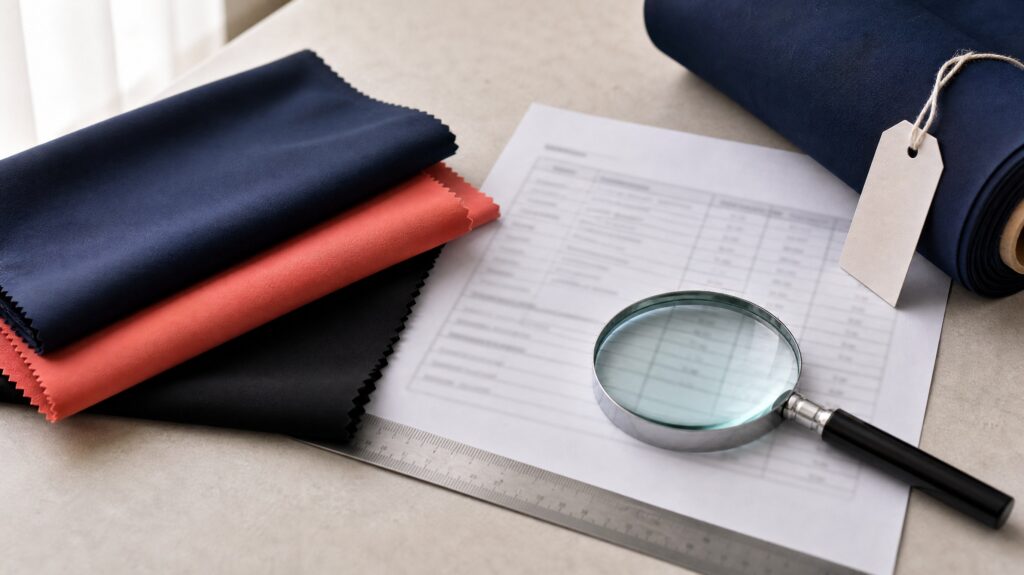
A useful report carries enough identifiers to connect it to the order: mill or supplier, lot or batch number, production date, colorway, composition, weight and finish. Some labs also record the sample submission date and the name of the person who submitted it. Those details let you match the document to the packing list, the roll labels and the approved quality.
Ask for the lot number even when the answer is inconvenient. If the mill tests a continuous production lot twice a year and sends the same report to every buyer, the result may work as a baseline, but it is not evidence for your order. The same applies to a report on a lab dip, a salesman sample or a development yardage. Those prove what the mill could do at that moment, not what it shipped.
When a trading company supplies the fabric, ask which mill produced the lot and whether the report came from that mill. A report from another mill is not automatically wrong, but it describes a different fabric until composition, weight and construction have been matched.
The test method is part of the result
Two labs can test the same fabric and publish different numbers without either one being careless. Methods differ in specimen size, orientation, conditioning, exposure time and the scale used to report change. If the method is missing, you cannot compare the number with anything else.
For swimwear, a few methods come up often. The table below lists common options, not equivalents. A result from one method should not be treated as a result from another without confirmation from the lab.
| Property | Methods you may see on a report |
|---|---|
| Colorfastness to chlorinated water | ISO 105 E03, AATCC 162 |
| Colorfastness to light | ISO 105 B02, AATCC 16 |
| Colorfastness to perspiration | ISO 105 E04, AATCC 15 |
| Dimensional change after washing | ISO 6330 with ISO 5077, AATCC 135 |
| Pilling | ISO 12945-2, ASTM D4970 |
| UV protection | AATCC 183, AS/NZS 4399 |
Check that the report names a standard number, not only an organization. “Tested to ISO” tells you almost nothing. “ISO 105 E03, 2018” gives you a method and a version. If a buyer in the EU asks for one method and the lab used another, the result may still be acceptable. Write down the difference and get it accepted by the brand before the labels are printed.
The scale matters too. Color change is often reported on a 1 to 5 gray scale. Pilling uses a 1 to 5 visual scale. Shrinkage is a percentage. UPF is a ratio. A report that says “grade 4” without naming the property and the scale has not told you enough to make a decision.
Read the specimen state, not just the result
Swimwear is worn stretched, wet and exposed to chlorine, sunlight and sunscreen. A lab result taken on a dry, flat swatch is a starting point, not the conditions the garment will meet.
Ask how the specimen was prepared. Was it tested flat or stretched to the fit elongation? Dry or wet? Before or after a wash cycle? Along the length or across the width? For a knit, the direction can change the result, especially for elongation, recovery and shrinkage.
UPF is a good example. Stretching a knit opens the structure and can let more UV through. Wetting changes how the fabric scatters light. A UPF rating measured on a flat dry swatch may not hold on a body in the water. If the brand plans to print a UPF claim, the test should reflect the state the claim will be used in, and the label wording should follow the rules of the market where it is sold. Color has a similar limit. A chlorine test run at one concentration for one duration is not a guarantee for every pool, spa or hot tub. The guide to colorfastness testing under chlorine and sunlight goes deeper on those conditions.
Shrinkage needs the same scrutiny. One wash at one temperature is not the same as five washes at the temperature your care label allows. If the label says machine wash cold and line dry, test that cycle. If most customers will hand wash, test that too. The number should follow the care story you will print.
A pass needs your specification
A report can say pass and still tell you very little. The word only means something if you know the limit it was measured against. If the acceptance limit is not printed, the verdict belongs to the lab or the mill, not to you.
Write the limits into the tech pack and the purchase order before the fabric is tested. Examples might be a color change of at least 4 on the gray scale, shrinkage within a stated percentage, a pilling grade of 4 or better, or a UPF rating that still meets the claim after stretch and wetting. The right numbers depend on end use, market and price point. Do not copy another brand’s spec without checking the method behind it.
A useful report shows the measured value, the method and the limit it was compared with. If the only words on the page are “pass” and a signature, ask for the underlying data. If the mill writes the limit after seeing the result, the limit describes the result. It is not a specification.
Color needs its own check. Dark shades, pale shades and prints do not behave the same way. Testing only the easiest color in the range can leave the worst case unmeasured. At minimum, test the color most likely to fail and the one closest to the volume seller. If the print covers most of the panel, test the printed fabric, not only the base cloth.
What the report does not cover
A fabric test report covers the cloth. It says nothing about seam strength, elastic recovery, strap attachment, hardware corrosion, pad performance, fit or print adhesion. Those are separate checks, and some of them matter more to the customer than a colorfastness grade. They belong in the wider work to evaluate swimwear fabric quality before bulk production, not in a single test report.
The report also does not prove that every roll in the order came from the tested lot. That is a packing question. Roll labels, packing lists and in-process checks connect the report to the goods. Without that chain, the report describes a fabric in general.
Certificates are another category. A certificate of compliance may state that a product meets a standard, but it often does not show the measured values or the specimen state. If a customer or retailer asks for evidence, the test report behind the certificate is usually the more useful document. Ask for both when both are claimed.
When to ask for a new report
A report does not expire on a fixed date, but it stops describing the current production when the yarn, knitting, dyeing or finishing source changes. Ask for a new report when:
- the mill or fabric source changes;
- a new colorway or print is added;
- the finish changes, including softeners or performance finishes;
- a previous lot failed and the mill reworked the fabric;
- the report is older than the production window and no lot number ties it to the current order.
If the report carries an accreditation mark, check that the method in question falls within the lab’s scope. A lab can be accredited for some tests and not others. The mark alone does not tell you which.
A short checklist before you approve the lot
Use this list when the report lands:
- The mill or supplier name matches the one on the packing list.
- The lot or batch number matches the rolls or the production record.
- The colorway and print match the purchase order.
- Composition, GSM and finish match the approved quality.
- The report names a test method and a version, not only an organization.
- The specimen state is stated: flat or stretched, dry or wet, before or after wash.
- The measured result is compared with a limit you agreed to.
- The report date is after the bulk lot was produced, not before.
- A copy sits with the purchase order and the bulk sample.
If any line is missing, ask for it before you approve. A short email now is cheaper than a re-test, a re-dye or a markdown later.
What Hongxiu can confirm
Hongxiu’s swimwear fabric guide states that colorfastness to chlorine, sunlight and sweat, plus shrinkage and pilling, can be confirmed to standard test methods when the market requires it. The quality control process covers in-process and final inspection, and optional lab tests can be arranged on request. Tests requested by the customer are paid by the customer.
That is what the fabric guide and the quality control page commit to. It does not mean every fabric in the range has a current report for every colorway, and it does not replace a test your retailer or market requires. If you need a specific standard, a specific specimen state or a report from an accredited lab, confirm it before the order is placed. The earlier the test plan is agreed, the less likely the report arrives after the cutting ticket.
If you are specifying a fabric or reviewing a mill report, send the composition, GSM, color reference and the standard your market needs. The OEM swimwear manufacturing team can confirm what can be tested, what the report will cover and where a separate garment test is needed.
When the lot, method, specimen state and limit all line up, the report is worth filing.