
Bridging the Gap: Why AI-Generated Swimwear Designs Still Need Expert Manufacturing
When AI tools generate captivating swimwear designs, they skip one critical reality: manufacturing feasibility. A stunning digital render may suggest construction, trims, and fabrics that simply cannot be physically assembled into a wearable, cost-effective swimsuit. This article explains the most common AI design pitfalls and shows how experienced swimwear manufacturers bridge the gap from concept to sample. For brand owners and sourcing managers, understanding these gaps is the first step toward a smoother product development process.
The Reality Gap: Common Pitfalls in AI-Generated Swimwear Designs
AI design tools often generate images based on learned aesthetics, not textile engineering. The result can be designs that look extraordinary on screen but would fail in production. Below are four pitfalls we regularly see when buyers send us AI-generated concepts.
Unrealistic Construction and Layering
AI may combine intricate layering, cutouts, and draped elements that require multiple seams and linings. In swimwear, every additional seam creates a potential point of leakage, chafing, or failure under stretch. What looks like a fluid garment in a render might need six separate panels, each with its own elastic and stitching sequence—driving up cost and production complexity.
Unfeasible Materials
AI might propose a fabric that never existed, or a combination that violates stretch recovery requirements. For example, a heavy faux leather bonded to mesh would make a swimsuit unwearable in water. Swimwear fabrics must be lightweight, chlorine-resistant, and capable of stretching consistently. Manufacturers must often suggest material substitutions that preserve the visual effect but work in practice.
Overcomplicated Trims and Hardware
Belts, buckles, studs, and metal rings appear frequently in AI-generated cyberpunk or avant-garde styles. However, hardware in swimwear must be rust-proof, lightweight, and securely attached without damaging the fabric. Each added component multiplies sourcing, quality testing, and assembly steps. A single design may require five different trims from separate suppliers, blowing out lead times.
Scale and Fit Issues
AI tools rarely understand human proportions or grading rules. A design that looks balanced at one size may distort when scaled to a size range. Without manufacturing knowledge, the first sample often arrives too small at the hips, too loose at the bust, or with unflattering tension points.
| AI Design Assumption | Manufacturing Reality |
|---|---|
| Intricate beading and embroidery are easy to add. | Beading requires manual handwork, increases cost by 40–60%, and extends production time. |
| Any fabric can handle digital printing. | Sublimation works best on white polyester. Dark or textured fabrics limit print vibrancy and fastness. |
| Complex draping needs no structure. | Swimwear draping often demands hidden linings, elastics, or bonding to maintain shape when wet. |
| One size can scale cleanly to all sizes. | Grading swimwear requires adjusting curves and tension points; AI ignores body mechanics. |
Why Manufacturing Expertise Is Irreplaceable
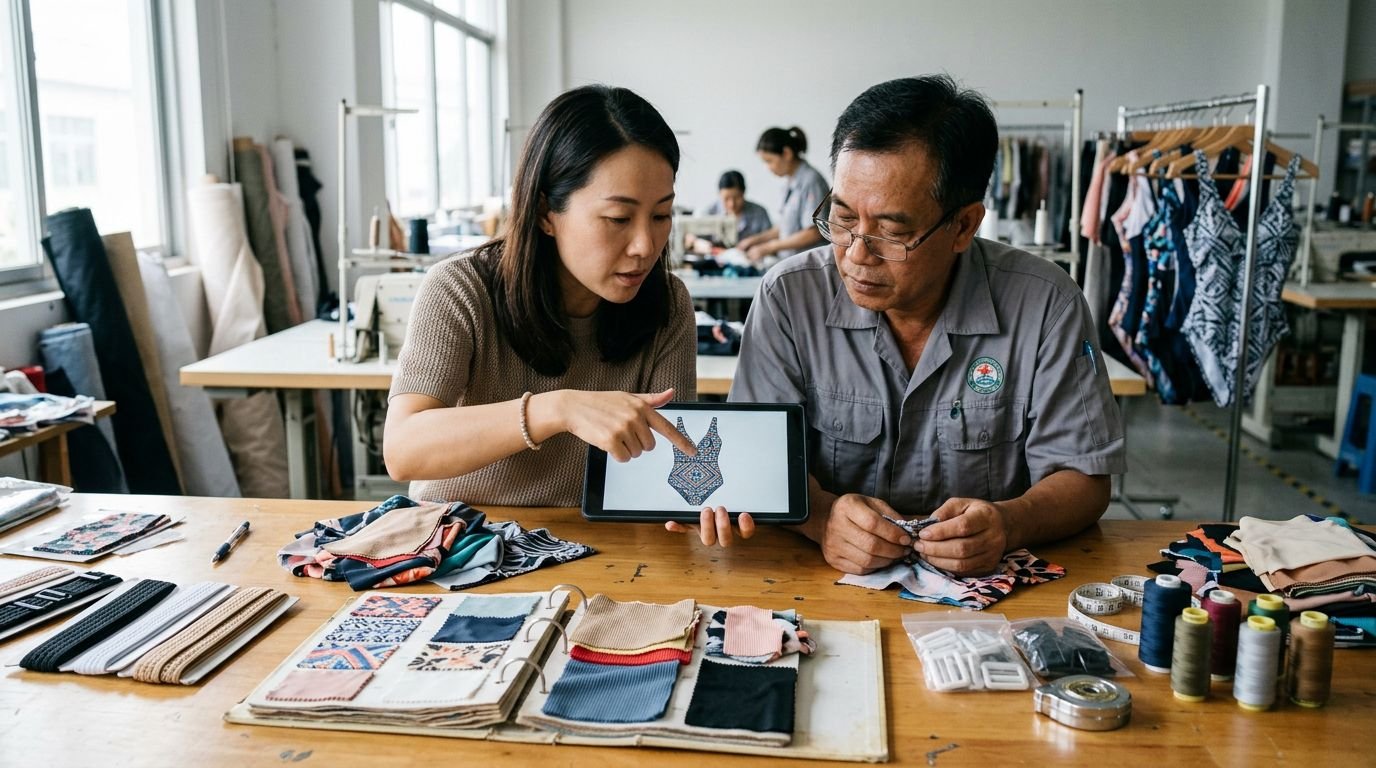
While AI can generate ideas, only experienced swimwear manufacturers can translate them into wearable, saleable products. Here is what that expertise looks like at each stage.
Feasibility Assessment and Cost Estimation
A good manufacturer reads an AI design and immediately flags construction risks. They can break down the design into panels, estimate fabric consumption, and calculate labor minutes. This early feedback prevents a beautiful but unprofitable design from moving forward.
Material Substitution and Sourcing
When the AI picks an impractical material, the manufacturer suggests alternatives that match the intended look and feel. For instance, instead of real leather strapping, they might recommend a high-density PU trim with similar visual weight but better water performance and cost.
Construction Simplification Without Losing Design Intent
Experienced pattern makers know how to combine panel lines, reduce seams, and engineer construction that works on a sewing line. The goal is to retain the design’s signature while making it producible at scale. This is often where AI ideas get edited for reality—a process that requires open communication between buyer and factory.
Sampling: Where Theory Meets Practice
The sample is the first physical test. Manufacturers create a prototype, often adjusting fabric, colors, and trims along the way. Fit revisions follow, with comments like ‘reduce strap width by 1 cm’ or ‘add more elastic at the leg opening’. AI models cannot predict these tactile adjustments.
How AI Can Still Support Swimwear Production
AI is not the enemy. In fact, it brings two real advantages to the swimwear production floor. First, AI can quickly recommend base patterns based on historical data, helping factories speed up the block development stage. Second, AI allows buyers to visualize different prints on a design before committing to sampling. This can reduce early-stage indecision and improve communication. Yet these tools remain assistants to human expertise, not replacements.
A Practical Checklist for Buyers Using AI Designs
- Provide high-resolution design files with multiple views (front, back, side).
- Specify your target retail price range so the manufacturer can reverse-engineer cost.
- List any must-have trims or materials—and be open to alternatives.
- Include size chart references or your intended size run.
- Mention the end use (surf, lounge, competition) to guide stretch and durability requirements.
- Share 1–2 reference garments that approximate the look and construction you want.
FAQ
Can a manufacturer perfectly replicate my AI design?
Almost never. Every design goes through an engineering filter. Your manufacturer will propose practical adjustments that preserve the overall aesthetic while making the piece wearable, durable, and cost-effective. Expect iterative sampling.
What if my AI design uses materials I cannot name?
That is common. Send your design with notes on the desired handfeel and visual effect, and your manufacturer will suggest appropriate materials. They may also send a material swatch set for your approval before sampling.
How many samples will I need before bulk production?
For complex AI-originated designs, expect at least two to three samples. The first sample tests basic fit and construction. The second incorporates your comments and final trims. A third may be needed for final approval, especially when hardware or prints are involved.
If you have AI-generated swimwear designs and need a manufacturing partner who can assess feasibility, guide material choices, and manage the sampling process, contact Hongxiu. Our team regularly reviews AI concepts and helps brands turn ideas into wearable products.


