
Swimwear Manufacturing Process: Complete Guide for Brands
For a swimwear brand, the manufacturing process is not just a factory timeline. It is the system that turns a design idea into a consistent, sellable product. Every stage affects fit, durability, cost, delivery risk, and the buyer’s ability to scale from samples to bulk production.
This guide explains how professional swimwear manufacturing works from the first specification to final packed goods. It is written for brand owners, sourcing managers, online retailers, and private-label buyers who need to understand what happens inside the factory before they place an order.
1. Start with a Clear Product Brief
Before a factory can quote or sample accurately, the buyer needs to define the product direction. A useful brief normally includes target customer, style type, expected retail price, order quantity, size range, fabric preference, color or print direction, branding requirements, and launch timing.
If you are still choosing between existing styles and full custom development, start with a commercial decision first. Our guide to private label vs custom swimwear costs explains how MOQ, sampling time, and development complexity affect the best path for a new collection.
2. Build the Tech Pack Before Sampling
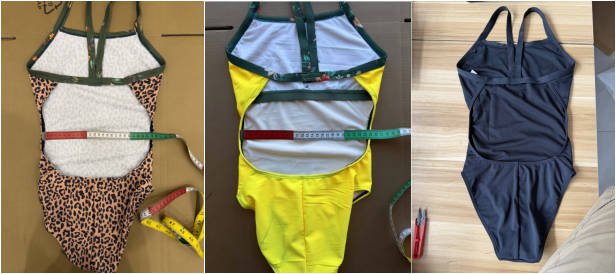
The tech pack is the production blueprint. It translates the design into factory instructions: flat sketches, measurements, grading rules, seam construction, fabric and lining details, trims, labels, packaging, print placement, and tolerance requirements.
For swimwear, the tech pack matters more than in many apparel categories because stretch fabrics leave little room for vague instructions. A small change in elastic tension, lining stretch, strap length, or leg opening can change how the garment fits on the body.
If your team does not yet have a complete specification, use our swimwear tech pack guide as the next step. A strong tech pack reduces sample revisions and helps the factory quote with fewer assumptions.
3. Select Fabric, Lining, and Trims
Fabric selection drives both product performance and cost. Common swimwear fabrics use nylon-spandex or polyester-spandex blends, but the right choice depends on the style, print method, handfeel, compression level, colorfastness requirement, and target market.
Buyers should evaluate stretch recovery, opacity after wetting, chlorine resistance, UV exposure, pilling risk, lining compatibility, and whether the material suits digital printing or solid-color production. For a deeper material breakdown, see our swimwear fabric selection guide.
Trims also need early planning. Rings, sliders, clasps, underwires, pads, labels, hygienic liners, hang tags, and packaging all affect lead time. Metal trims should be checked for corrosion resistance, especially when the product will be exposed to saltwater and chlorine.
4. Create the First Sample
The first sample is not just a visual prototype. It tests whether the pattern, fabric, lining, elastic, stitching, and construction can work together. At this stage, the buyer should review fit, comfort, stretch recovery, seam placement, print alignment, and whether the product matches the intended price point.
Good sample comments are specific. Instead of saying “make it fit better,” note whether the bust coverage, strap tension, waist height, back rise, leg opening, or torso length needs adjustment. Clear comments make the next sample round faster and more accurate.
5. Confirm Pattern, Size Set, and Pre-Production Sample
Once the prototype is close, the factory prepares a corrected pattern and may produce a size set. This checks whether the grading works across sizes, not only on one sample size. Swimwear grading requires care because stretch does not scale in a simple linear way.
Before bulk production, a pre-production sample should confirm all final decisions: fabric, color, print, lining, trims, labels, packaging, measurements, stitching, and finishing. The approved pre-production sample becomes the physical standard for the production line and final inspection.
6. Cut Fabric with Stretch Control
Cutting swimwear fabric is different from cutting stable woven fabric. Stretch materials can shift, relax, curl, or distort. The factory needs to control fabric laying, grain direction, stretch direction, marker efficiency, and cutting accuracy.
Accurate cutting protects fit consistency. If the fabric is pulled during laying or if pieces are cut off-grain, the finished swimsuit may twist, bag, or feel uneven on the body. This is one reason experienced swimwear factories build cutting checks into the production workflow.
7. Sew with Swimwear-Specific Techniques
Swimwear sewing requires machines and operators that can handle stretch without broken seams, puckering, or wavy edges. Common operations include overlock seams, coverstitch hems, elastic attachment, bar-tack reinforcement, binding, and decorative finishing.
Edge finishing is especially important because leg openings, necklines, armholes, and waistbands must be comfortable and secure after repeated stretching. For construction details, read our swimwear edge finishing guide.
8. Inspect Quality During Production
Quality control should not wait until the final carton is packed. A professional swimwear manufacturer checks incoming materials, cutting accuracy, sewing quality, measurements, elastic tension, trim placement, print alignment, thread trimming, and packaging consistency throughout production.
If you are evaluating a new supplier, quality control should be part of your audit checklist. Our article on 7 key metrics to evaluate swimsuit manufacturers explains how to assess certifications, equipment, QC systems, communication, MOQ, pricing, and after-sales support.
9. Pack, Ship, and Plan the Next Production Cycle
After final inspection, swimwear is trimmed, pressed if needed, labeled, packed in individual bags, and arranged into cartons according to the buyer’s packing instructions. Branding details such as hang tags, woven labels, size stickers, barcode labels, and packaging bags should be confirmed before production begins.
For repeat orders, the best time to review improvements is immediately after the first production run. Buyers should record fit comments, customer feedback, sales performance, return reasons, and any quality issues. This creates a clearer basis for the next bulk order.
How to Use This Process as a Buyer
If you are sourcing remotely, ask the factory to show each production area by video: sample room, fabric storage, cutting table, sewing line, QC area, and packing area. Our remote swimwear factory audit guide gives a practical checklist for that conversation.
The most reliable swimwear production projects are built on clear specifications, realistic timelines, suitable materials, and direct communication. When the buyer and manufacturer align early, sampling becomes more efficient and bulk production carries less risk.