The men’s swim trunks market is undergoing an underappreciated transformation. Looking ahead to 2027, the global demand landscape for men’s swimwear has evolved far beyond simply being “shorter” or “flashier.” What buyers and brand owners truly care about now are breakthroughs in fabric technology, the practical implementation of sustainable production, and the agility of supply chain responsiveness. This article takes a manufacturing-frontier perspective to outline five key trends shaping men’s swim trunks production in 2027, helping overseas swimwear procurement decision-makers gain a competitive edge in their next season’s sourcing strategy.

Trend 1: Sustainable Fabrics Shift from “Selling Point” to “Entry Requirement”
By 2027, sustainable materials will no longer be just a marketing bonus for brands—they will become an entry barrier for mainstream European and American retail channels. An increasing number of retailers are requiring suppliers to provide traceable eco-friendly fabric certifications, especially for high-turnover items like men’s swim trunks.
Mass Adoption of Recycled Polyester
Recycled polyester, made from discarded plastic bottles or industrial waste, has become the most mainstream sustainable material option for men’s swim trunks manufacturing. Its performance—including chlorine resistance, color fastness, and quick-dry properties—is now highly comparable to traditional virgin polyester. For printed men’s board shorts and swim trunks, a fabric blend of 85% recycled polyester + 15% spandex delivers vivid color saturation while meeting environmental compliance requirements.
The Rise of Bio-based Nylon and Biodegradable Spandex
Beyond recycled polyester, bio-based nylon derived from plant sources such as castor oil is emerging as a premium fabric choice for high-end men’s swim trunks. This fabric offers superior softness and abrasion resistance compared to polyester, making it particularly suitable for solid-colored fitted swim briefs. Meanwhile, biodegradable spandex technology is maturing rapidly. Although current costs remain higher than conventional spandex, it is expected to gradually enter commercial mass production by 2027.
Trend 2: Digital Printing Technology Drives “Small-Batch, Quick-Response” Upgrades for Men’s Swim Trunks
The consumer end of men’s swim trunks is showing a clear trend toward personalization—buyers are no longer satisfied with generic solid colors or basic stripe patterns, and are increasingly drawn to unique prints and designer collaboration elements. This shift places higher demands on brand inventory management and has directly driven the deep adoption of digital printing technology in men’s swim trunks manufacturing.
Manufacturing bases located in the world’s core swimwear industry belts, such as Xingcheng, China, hold significant advantages in digital printing resources. Hongxiu Clothing Co., Ltd., for example, operates within an industrial cluster that hosts numerous specialized digital printing factories capable of offering free polyester print sampling, dramatically shortening the timeline from design concept to sample. For B2B clients sourcing men’s swim trunks, this means lower trial costs for testing multiple patterns, faster response to market feedback, and true small-batch, quick-turnaround production—with minimum order quantities as low as 50 pieces per style per color.
Trend 3: Fit Upgrades—Re-balancing Functionality and Comfort
Men’s swim trunks in 2027 will feature increasingly refined fit designs. Different usage scenarios demand different cuts, and manufacturers must have the flexible production capability to handle multiple fits and size ranges.
Manufacturing Essentials for Three Main Fits
- Briefs / Jammers: Primarily for competitive training or fitness swimming, these require exceptionally high elastic recovery in the fabric. A blend of nylon + spandex (e.g., 82% nylon + 18% spandex) is recommended, with fabric weight controlled at 180–200 gsm to balance compression and comfort.
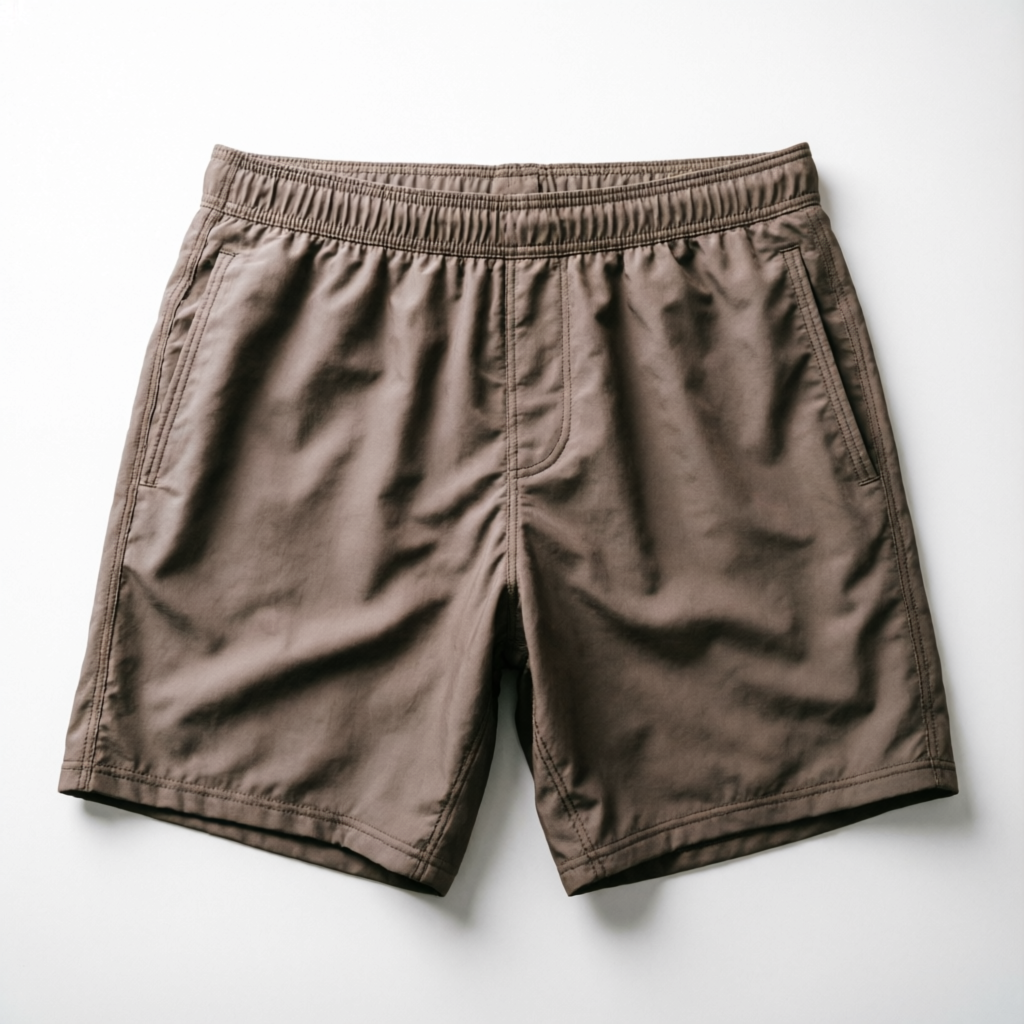
- Board Shorts: The go-to style for casual leisure, typically with an above-the-knee inseam. These products demand attention to waistband drawstring design and mesh drain liner construction details. Recommended sewing techniques include double-needle reinforcement and overlock edge finishing to prevent thread unraveling.
- Hybrid Swim Shorts (5-inches): The trend toward cross-scenario wear has given rise to “land-and-water” styles. The manufacturing challenges lie in waterproof zippered pockets, balanced quick-dry fabric performance, and structural strength for multi-pocket layouts. These styles require higher precision from sewing equipment—particularly the coordinated use of coverstitch and overlock machines.
Trend 4: Technical Detail Upgrades for Functionality and Comfort
Competition in men’s swim trunks is deepening from “looking good” to “feeling great.” On 2027 procurement checklists, the following technical details will receive increasing attention:
- Liner Upgrades: Traditional mesh liners are gradually being replaced by high-stretch four-way elastic liners. Some styles even adopt a liner-free design with outer-facing locked-edge stitching to cater to consumers seeking a “barely there” feel.
- Chlorine Resistance & UV Protection: For men’s swim trunks frequently used in pools or tropical beaches, fabrics need excellent chlorine resistance and UPF 50+ sun protection. Polyester + spandex blends perform better in chlorine resistance than nylon + spandex, making them the preferred choice for pool-use scenarios.
- Label Experience Optimization: Traditional sewn-in woven labels are being replaced by heat transfer labels and TPU labels. Heat transfer labels print size and care information directly onto the inner fabric using thermal transfer technology, completely eliminating tag friction against the skin. This has become a standard feature for mid-to-high-end men’s quick dry swim trunks.
Trend 5: Supply Chain Capability Becomes a Core Criterion for Brand Factory Selection
For overseas swimwear buyers and brand owners, price is no longer the sole deciding factor when selecting men’s swim trunks manufacturing suppliers in 2027. Comprehensive supply chain capabilities—including production flexibility, process depth, and response speed—are becoming far more important evaluation metrics.
Advantages of the Manufacturer-Exporter Model
Factories operating under a manufacturer-exporter model hold inherent advantages in cost control and quality consistency. Direct sourcing from the original factory allows brands to eliminate intermediate cost markups while enjoying greater transparency throughout the entire production process.
Process Depth Determines Product Ceiling
Men’s swim trunks may appear simple in design, but the gap between premium and mediocre products often lies in the process details. An experienced technical team—such as one with three decades of swimwear design and manufacturing expertise—can precisely control every step, from fabric cutting orientation (ensuring print alignment), to sewing tension (preventing trunk deformation), to elastic band fastening methods (ensuring no loosening after repeated wear). Every detail directly impacts end-consumer repurchase rates.
The Commercial Value of MOQ Flexibility
Facing the uncertainties of the 2027 market, more and more brands are adopting a “small-batch test + reorder on hot sellers” strategy. Manufacturers that can support MOQs as low as 50 pieces per style enable brands to significantly reduce inventory risk while iterating quickly during the new product testing phase. This flexible manufacturing capability is becoming a core competitive advantage in men’s swim trunks supply chains.
Conclusion
The 2027 men’s swim trunks manufacturing market will be a full-scale competition across materials, technology, craftsmanship, and supply chain efficiency. For overseas swimwear buyers, brand owners, and wholesalers, securing manufacturing partners early who possess eco-friendly fabric application capabilities, digital printing resource advantages, and flexible production systems will be the key to winning in the next round of market competition.
If you are looking for a professional and reliable men’s swim trunks manufacturer and would like to learn more about how these trends can be implemented in actual production, please feel free to reach out to us. With 30 years of swimwear manufacturing experience and the supply chain advantages of being located in the Xingcheng industrial cluster, we are committed to providing global clients with high-quality, cost-effective custom men’s quick dry swim trunks and board shorts.