
For many European and American swimwear brands and buyers, Bali, Indonesia has long been a go-to sourcing destination in Southeast Asia. Its vacation culture, relatively low labor costs, and years of hand-stitching tradition made it attractive. However, as the global swimwear market grows more competitive and order lead times shrink, a growing number of B2B buyers are rethinking their supply chain strategy — and shifting production from Bali to China is becoming a trend worth serious attention.
This article breaks down the business logic behind this shift across four dimensions: cost structure, supply chain efficiency, craftsmanship, and delivery reliability.

1. Apparently Cheap Labor, Hidden Higher Total Costs
Many buyers initially choose Bali for its lower wage levels. But when you look at the total landing cost of swimwear sourcing, Bali’s “cost advantage” is often offset by several significant factors:
1.1 Imported Materials Drive Up Fabric Costs
Swimwear production demands specialized fabrics—nylon, spandex, polyester-spandex blends, and various performance textiles—and the supply chain for these materials is heavily concentrated in China. Bali has virtually no local production of swimwear-grade fabrics, so factories must import from China, South Korea, or Taiwan. This adds international freight costs, import duties, and lengthens procurement lead times. In contrast, factories in China’s swimwear clusters (such as Xingcheng in Liaoning, Jinjiang in Fujian, and Foshan in Guangdong) can source all fabrics and trims locally in one stop, eliminating the import markup entirely.
1.2 Limited Accessories & Trims Availability
Swimwear requires a wide range of accessories—adjustable sliders, padded cups, zippers, elastic webbing, silicone tape, and more. In Bali, local options are extremely limited and quality is often inconsistent. Buyers frequently find themselves having to accept whatever is available. In China’s mature industrial clusters, dozens of types of trims needed for a single swimsuit style can be sourced within a few kilometers. Factories can precisely match trim specifications to client design requirements, with traceable quality and competitive pricing.
1.3 Hidden Communication & Quality Control Costs
Bali’s factory workforce consists mainly of local artisans with limited experience interpreting standardized quality requirements and technical drawings from international buyers. Rework during sample approvals and discrepancies between samples and bulk production are common. These hidden trial-and-error costs ultimately add to the buyer’s total order cost.
2. Supply Chain Efficiency: The “China Speed” Advantage of Industrial Clusters
Swimwear is a highly seasonal business. Whether spring/summer new arrivals hit shelves on time directly impacts a brand’s cash flow and profitability. In this dimension, the supply chain efficiency of China’s swimwear clusters offers a near-overwhelming advantage.
2.1 From Sample to Production in Record Time
Take Xingcheng as an example. As one of the world’s best-known swimwear clusters, it hosts a complete chain of businesses from fabric knitting, digital printing, cutting and sewing, to finishing and packaging. For an integrated manufacturer like Hongxiu Clothing Co., Ltd., the cycle from receiving a design drawing to completing sample confirmation typically takes just 5–7 working days. Bulk production scheduling is also significantly faster than Southeast Asian competitors. Relying on Xingcheng’s comprehensive supply chain, a standard order from confirmation to shipment can be completed in 25–35 days, while Bali factories—even without fabric import delays—typically require 40–60 days.
2.2 Digital Printing Speed Advantage
One hallmark of the swimwear industry is the rapid turnover of print patterns and designs. China’s Xingcheng cluster has abundant digital printing resources, supporting both heat transfer (sublimation) printing on polyester-spandex fabrics and direct-to-fabric digital printing on nylon-spandex. For polyester prints, a single sample run takes just about 3 days, and many factories offer free polyester print sampling. In Bali, professional digital printing equipment is scarce. Printing is often outsourced to other regions, resulting in longer turnaround times, higher communication costs, and a greater risk of errors.
2.3 Flexible MOQs for Buyers of All Sizes
For emerging and mid-sized swimwear brands, Bali factories often require high minimum order quantities (MOQs) to spread their costs, making it difficult for newer brands to enter. By contrast, many Chinese swimwear factories now offer flexible MOQ policies—as low as 50 pieces per style per color—combined with tiered pricing where larger volumes unlock lower unit costs. This approach allows brands to test new styles with small batches while maintaining a smooth production channel for reorders on winning styles.
3. Craftsmanship & Quality Control: A Clear Gap in Expertise
Swimwear is fundamentally different from regular apparel. It demands higher precision in stitching, control of fabric stretch, and accuracy in sizing systems.
3.1 Deep Technical Expertise
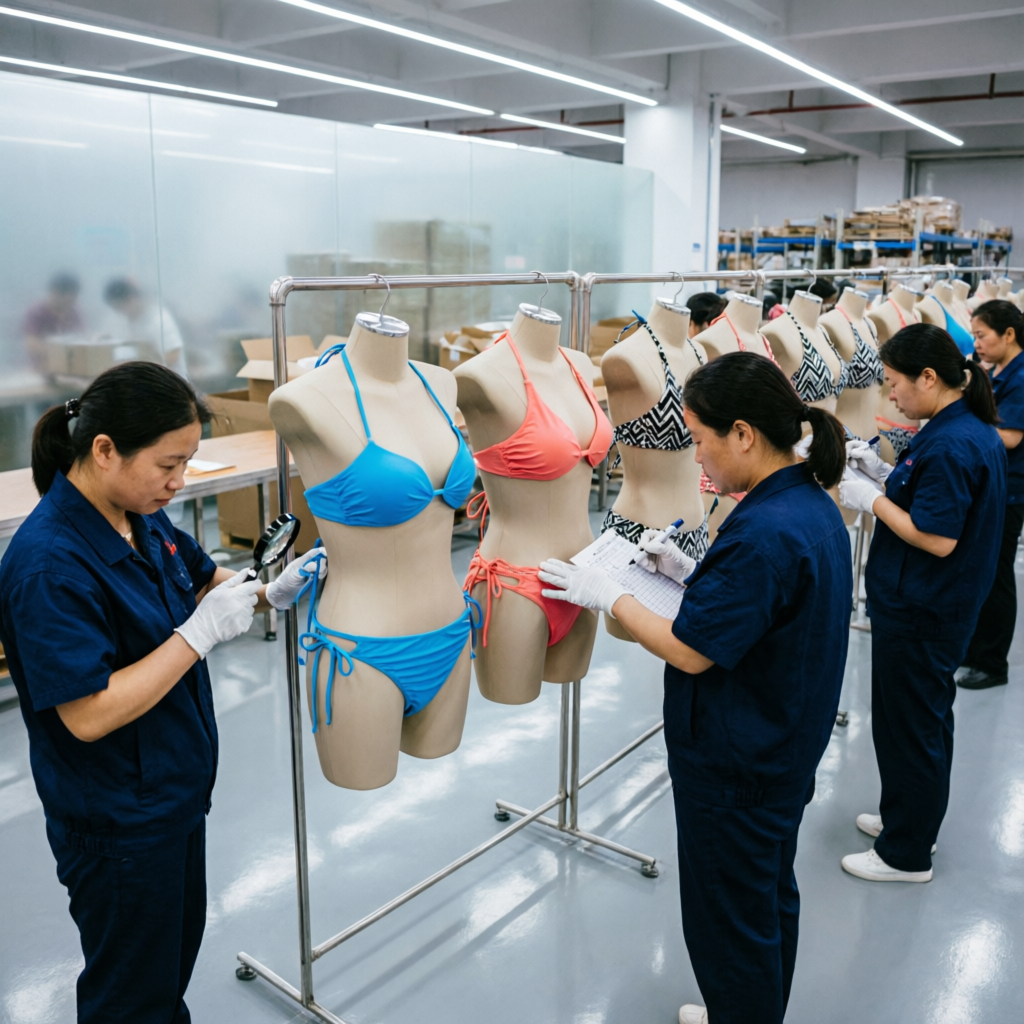
China’s swimwear export industry has cultivated a large pool of experienced pattern makers and sample tailors over more than two decades. In Xingcheng, many factory founders and technical leads have 10 to 30+ years of swimwear manufacturing experience, with deep knowledge of pattern design and construction details across a wide range of styles—bikinis, one-piece swimsuits, tankinis, plus-size swimwear, and more. While Bali’s hand-stitching tradition has its own appeal, its level of process standardization and specialized swimwear technology for mass production still lags noticeably behind.
3.2 Robust Size Grading Systems
For swimwear brands targeting European and American markets, sizing accuracy is critical. Mature Chinese swimwear factories typically offer full size grading services from base size to multi-size sample production, helping clients verify grading results before bulk production to ensure consistently good fit across all sizes. Bali factories, on the other hand, face more pronounced challenges with size consistency when handling complex multi-size orders.
4. Delivery Assurance & Logistics Efficiency
For B2B buyers, whether a supplier delivers on time can make or break an entire sales season.
China’s port infrastructure is world-class, with well-developed road networks connecting major swimwear production zones to Shanghai Port, Ningbo Port, and Shenzhen Port. From Xingcheng, for example, goods can reach an export port in just 1–2 days. Bali, being an island, requires shipments to go through its local port or transit via Jakarta, introducing more logistics nodes and greater uncertainty.
What’s more, the production capacity of Chinese swimwear factories is generally far larger than Bali-based workshops. A mid-sized Chinese swimwear manufacturer can produce tens of thousands to hundreds of thousands of pieces per month, offering ample production flexibility during peak seasons. Bali factories are typically small workshops facing clear capacity bottlenecks on larger orders, and delayed shipments are not uncommon.
At the end of the day, sourcing decisions are about finding the optimal balance among cost, efficiency, and quality. Bali once attracted orders with its unique cultural appeal and low labor costs. But as the swimwear market enters an era demanding “fast response + stable quality + controlled costs,” the comprehensive advantages of China’s swimwear clusters become undeniable.
From local fabric and trim sourcing, flexible small-batch production and quick-response digital printing, to integrated manufacturing quality control, Chinese swimwear factories are serving global buyers with greater professionalism and efficiency. If you’re looking for a long-term swimwear manufacturing partner, exploring Xingcheng—a world-class swimwear cluster—could be one of the most cost-effective moves in your supply chain optimization.
About Hongxiu Clothing Co., Ltd. We are a swimwear manufacturer based in Xingcheng, Liaoning, with years of domain expertise. Our main categories include bikinis, one-piece swimsuits, tankinis, and children’s swimwear. We support MOQs as low as 50 pieces per style and offer free polyester print sampling. If you have swimwear sourcing needs, feel free to contact us for detailed pricing and sample support.