
Wool-blend crinkle swimwear fabric: what the Bond-eye, Maxxam and Woolmark launch means for sourcing teams
Australian swimwear label Bond-eye, fabric developer Maxxam and Woolmark have introduced Maxxam Wool Crinkle, a wool-blend crinkle fabric for swimwear that the partners describe as a first of its kind. WWD’s Sourcing Journal reported the launch on October 8, 2026.
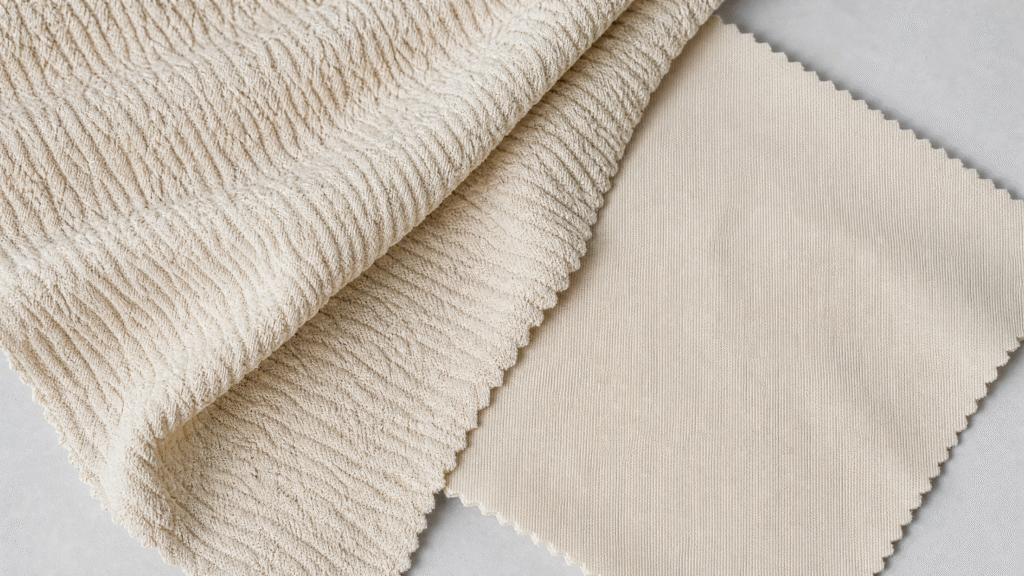
The fiber recipe is what product and sourcing teams should look at: 45 percent Australian Merino wool, 45 percent Tencel that the partners describe as sustainably made, and 10 percent elastane. It is a four-way stretch knit said to fit body sizes from extra-small through large without losing shape. The material debuts inside a 26-piece collection that mixes knit wool-blend swimwear with beach cover-ups. The partners say it will anchor an extended wool-blend swim and resort range, with more details due in early 2027.
What the partners announced
The fabric came out of a roughly two-year development process with a specialist knitting mill in Italy. Maxxam founder Rosemary Moore, who introduced tubular crinkle fabric more than four decades ago and has worked with Bond-eye for a decade, described repeated trials across yarns, blends, dyeing and finishing before the Merino and Tencel combination was settled. That points to a formulation problem, not a simple fiber swap.
Woolmark says it subjected the development to performance testing intended to confirm color will not fade when exposed to chlorinated pool water and seawater. Bond-eye chief executive Steve Philpott framed the project as a step toward reducing reliance on conventional synthetic fibers. Woolmark managing director Bryan Fry said the challenge was meeting swimwear’s technical demands without stripping Merino of its defining qualities. Designer Mim Goode positioned the collection as moving between swim, athleisure and beach-to-bar.
Those statements come from the launch partners. The report includes no independent lab data, no published test method or standard, and no third-party confirmation of the colorfastness result. Woolmark is a participant in the launch rather than a neutral evaluator, so its testing should be read as a partner-run check, not as an industry benchmark.
Why it sits on a material watchlist
Crinkle is a long-established swimwear texture, and the versions most programs source are synthetic stretch constructions. The launch frames the goal as reducing dependence on fossil-fuel-derived materials such as nylon and polyester. A Merino and Tencel knit with elastane therefore sits in the same visual and structural territory as a conventional crinkle, but with a natural-fiber story attached. That puts it in the same conversation as recycled, regenerated and bio-based swimwear materials covered in our sustainable swimwear fabric sourcing guide.
It belongs in the watchlist category, not the adoption category. A technology for swimwear teams to watch means that so far the only public evidence of use is one brand’s collection, and there is no sign of broader commercial uptake in the category.
Fry described the project as opening a broader pathway for Australian wool, which suggests the supply-chain intent runs past a single capsule. But ambition is not capacity. Nothing in the announcement establishes that mills beyond the one Italian knitter can produce the fabric at scale, or that it is available to other brands at all.
Claims that still need supplier-level verification
This is a launch announcement, and several questions that determine whether a fabric is genuinely sourceable go unanswered.
- Cost per meter, minimum order quantities, lead times and available production capacity.
- Care instructions, drying behavior, and how the knit feels and performs when wet.
- Pilling resistance, abrasion performance and stretch recovery over repeated wear.
- Resistance to sunscreen, body oils and UV exposure.
- Whether chlorine and salt affect elasticity, not only color.
- Certification documentation for the wool and the Tencel component.
- Durability evidence beyond colorfastness in chlorinated pool water and seawater.
Dye selection and finishing decisions drive fading performance, so anyone developing dyed solids or prints should ask for the underlying test reports rather than the summary language. Our swimwear color and print guide covers how those choices are typically handled in production.
Collection planning and the swim-to-resort blur
The 26-piece launch is built around pieces that cross categories: knit swimwear, cover-ups, athleisure and resort dressing. A single fabric platform spanning those uses appeals to buyers because it simplifies a buy and supports a coordinated retail story. If the extended wool-blend range does arrive in early 2027 as promised, resort and cruise planners would gain a second data point. Until then, treat the assortment logic as directional. It shows how one brand is approaching premium natural-fiber positioning, not proof that the fabric holds up across a full seasonal program.
How to test it against your own base fabrics
If a wool-blend story tempts you toward a natural or blended knit for a future drop, the practical step is comparison rather than commitment. Benchmark against what you already run. In our catalog that means nylon/spandex at roughly 82/18 and about 200 GSM for solids, and polyester/spandex at roughly 85/15 for prints, both available in matte and shiny finishes, as set out in the swimwear fabric guide. A wool-rich knit would need to match or beat those baselines on hand feel, recovery and wet performance to justify the added development risk.
Sourcing the fabric
If a base fabric does not exist yet, a sourcing service can shortlist mills and options. Hongxiu’s program runs a search at $20 per style, credited toward the sample fee if the material moves forward, with custom colors from 600 yards, no minimum on polyester prints, and nylon prints from 50 yards, as detailed on our fabrics and trims sourcing page. Ask any supplier to confirm minimums, timelines and fiber availability in writing, since published thresholds apply to the materials that service handles, not automatically to every blend.
Sampling before you commit
Whatever the fiber, a physical sample is the only honest test. Hongxiu’s swimwear sampling service is $50 per style for up to two pieces, typically 7 to 14 working days, with two free revision rounds and the fee credited back once bulk of the same style reaches 300 pieces. For a wool-blend crinkle, request pool-water and seawater immersion checks, repeated-stretch recovery tests, and a wet-hand evaluation before you place a seasonal buy.
Where this leaves sourcing teams
Bond-eye, Maxxam and Woolmark have introduced a wool-blend crinkle knit that now sits on the swimwear sourcing watchlist. The fiber composition, the multi-year development with an Italian mill, and the promised extended range in early 2027 make it worth tracking. It remains early-stage intelligence: the performance claims are partner-attributed, the cost and capacity picture is undisclosed, and adoption so far rests on a single brand. Add it to your watchlist, request the raw test data, and measure any natural-fiber alternative against your current base fabrics before it reaches a line sheet.