
What a kids’ swimwear spec needs that an adult style does not
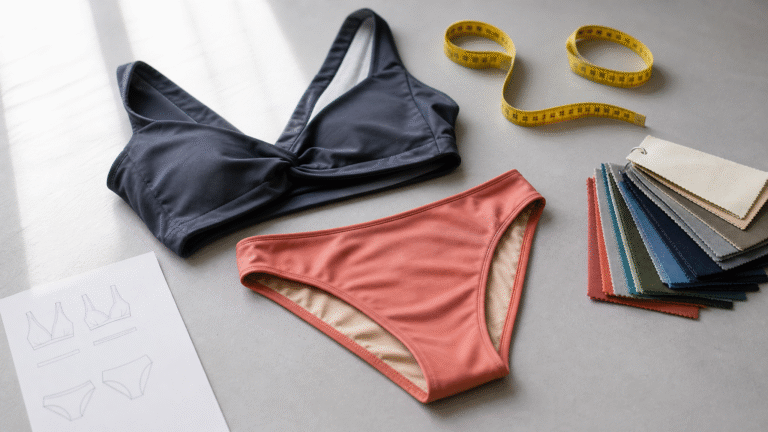
Most brands add kids’ swimwear by grading a best-selling adult pattern down. It saves a development round on paper, and it usually fails at the fitting stage. Children are not small adults. Their proportions, posture, skin sensitivity, and movement in water differ enough that a shrunken adult block produces the same short list of problems. Leg openings ride up. Straps slip. Waistbands dig in. The fit stops working two months after delivery.
None of this is hard to avoid once the decisions live in the spec rather than being discovered after the bulk order ships. What follows covers the points where a children’s swim style needs a different answer from the adult version.
Why an adult pattern cannot simply be scaled down
Body proportions are the first issue. Children have proportionally shorter torsos and a different relationship between waist and hip, so a graded-down adult block tends to bind across the seat or gap at the waist. Build the style on a kids block developed from real measurements for the target age band instead.
Growth and movement matter too. A child grows between sampling and delivery, then keeps growing through the selling season, so a fit that is exact on the sample date can be tight by the time stock reaches the shelf.
Then there is comfort. Adults will tolerate a snug elastic or a scratchy closure if the style looks right. Children will refuse to wear the suit, and parents will return it.
Sizing and age grading
Use body measurements, not age labels, as the source of truth. Age bands such as 2 to 3 or 6 to 7 are useful for merchandising, but the pattern, spec sheet, and size chart should be driven by chest, waist, hip, torso, and height ranges.
Decide early how much growth room the fit allows. A little ease at the waist and leg is normal in kids’ styles. Too much and the suit slides during swimming. Adjustable features such as crossback straps or a tie waist can help, but each one adds a safety and trim decision, so keep the count low.
Document the size chart exactly as the buyer will see it, and check that the same numbers appear on the spec, the pattern, and the website. Our swimwear size guide shows how measurement ranges are presented to buyers, and the same discipline applies to a kids’ range.
Fabric and lining
The fabric questions do not change much. The priorities do. Look at fiber content, four-way stretch, recovery, and how the fabric behaves after chlorine and sunscreen. Children are in and out of pools and the sea more often, and the suit gets washed more frequently.
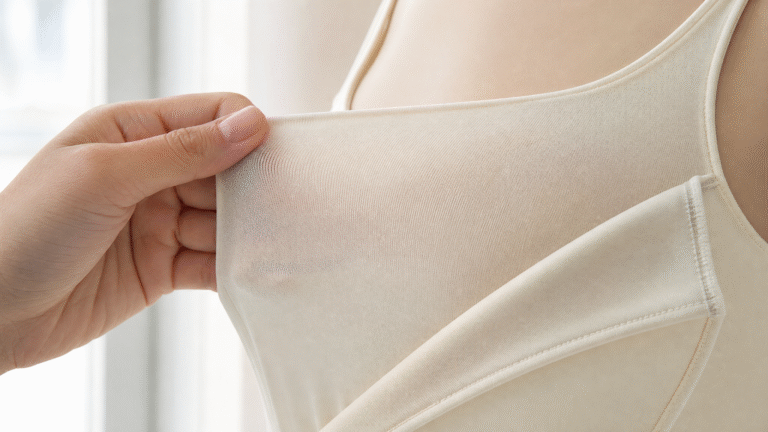
Lighter fabrics feel cooler and softer, and they are also more likely to turn see-through when wet. When a style uses a light color or a thin fabric, plan the lining as part of the design instead of an afterthought. This is the same lining decision that affects adult light-colored styles.
Lining also adds coverage and structure to the front panel, so confirm the lining content, weight, and color against the shell. Our swimwear fabric guide lists the performance factors to confirm with a mill before a style is booked.
Construction details that matter for children
- Covered elastic at the waist and leg openings reduces chafing, and the recovery should hold after repeated washing
- Flatlock stitching and clean seam finishes matter more on children’s skin, especially at the shoulder and side seams
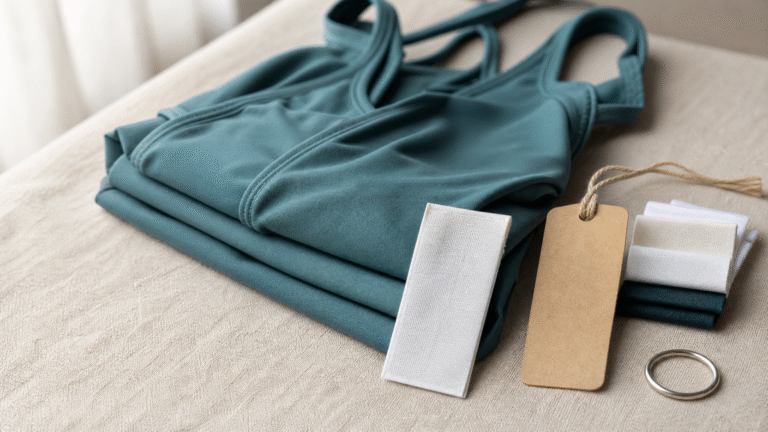
- Rings, sliders, and zipper pulls need smooth edges and a tested pull strength. On younger sizes, simplify or remove hardware where the design allows
- A scratchy care label at the side seam is a common complaint. Use a soft label or move it clear of the skin
- Removable pads are a loss and choking risk in small sizes. For younger age bands, discuss a sewn-in or no-pad build with the buyer
- The neckline and leg openings should stay in place during movement without cutting in. Fit them on children, not on a mannequin
Safety and compliance
Children’s clothing is regulated in ways adult swimwear is not. Cords and drawstrings are a specific area. The EU standard EN 14682 sets rules for cords and drawstrings on children’s clothing, including where they can appear and how long they can be, so read the standard for the destination market before a design locks in a waist tie, a neck cord, or a hood.
Chemical and physical testing is the other half. In the United States, children’s products require a Children’s Product Certificate based on third-party testing for the applicable rules, which can include lead and phthalates. Other markets run their own schemes.
What matters for a brand is narrower than the full rulebook: confirm which rules apply to the destination market and the age band, then ask the factory for test reports that match. A report for an adult style does not cover a children’s style, and a report for one market does not cover another.
What to test and document
Build the test list before bulk production, not after a problem appears:
- Colorfastness to chlorine, salt water, perspiration, and light
- Stretch and recovery after repeated extension
- Pilling and abrasion on the fabric and on any print
- Dimensional stability after washing
- Evidence for a sun protection claim, if the style makes one
- Component and pull tests for hardware and attached trims
Keep the approved test reports, the approved fabric and trim references, and the approved sample together. That pack is what protects a repeat order. Our quality control page describes how inspections are staged through production.
Sampling and fit approval
Fit a full size set on children in the target age band, in the water if possible. A child who stands still in a fitting room may still pull at the straps once they start moving. Ask the fit models or their parents where the suit rubs, rides, or slips.
Review the sample against the size chart and the safety decisions above. Approve a pre-production sample in the final fabric, color, and trims before bulk starts. If the kids’ pieces sit beside an adult collection as a matching set, check that the kids’ fit reads as the same design.
Planning the range and the order
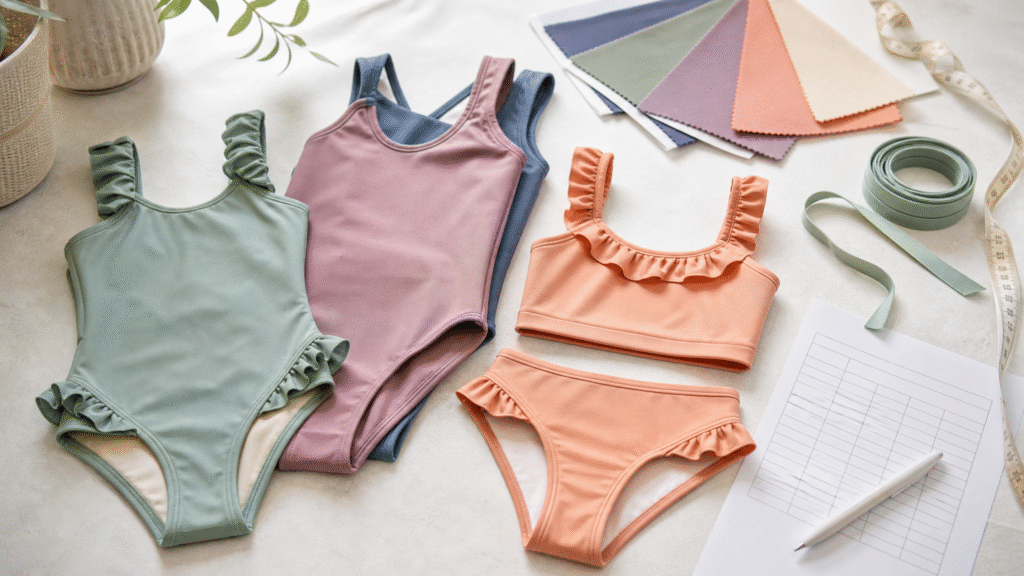
A kids’ range raises size-curve questions that adult styles do not. The buy usually spreads across more sizes and fewer units per size, so the size ratio and pack configuration matter. Decide the size range, the pack ratio, and the minimum per color before the quote, and confirm how the smaller sizes will be cut and packed. If the kids’ line sits beside an adult line, plan the color and print references together so a family set matches. Our private label swimwear page covers how a program is set up from the first style through repeat production.
A short pre-sampling checklist
Before a kids’ style goes to sampling, confirm:
- target age bands and body measurement ranges
- a kids pattern block rather than a graded-down adult block
- fabric, lining, and color checked for opacity and recovery
- covered elastics, flat seams, and no sharp or loose hardware
- cord and drawstring rules for the destination market
- the test list, including chemical and component tests
- the fit model plan for the target age band
- the size ratio and pack configuration
Next step
If you are adding a kids’ line, the quickest way to avoid a costly revision is to settle the spec before the first sample. Send the target ages, the destination market, and any adult styles the kids’ pieces should match. Those three inputs shape the pattern block, the safety checklist, and the sampling plan.