
Swimwear Elastic Specifications: How to Control Tension and Fit
Two swimsuit samples can use the same pattern and still fit differently because of the elastic. A small change in elastic length, stretch, or sewing tension can make a leg opening bite, a neckline gape, or a waistband ripple. The problem becomes harder to trace when the tech pack names only an elastic width and leaves the application method to the sample room.
A usable swimwear elastic specification connects the material to the garment zone and to a measurable result. Buyers do not need to prescribe every machine setting. They do need an approved elastic, a clear application length, a reference sample, and a repeatable way to check the finished edge.

Why elastic changes the fit
Swimwear fabric and elastic recover together, but they do not behave as one material. The shell may stretch easily while the elastic provides most of the hold at the leg, waist, neckline, or underbust. If the elastic is too short for the sewn edge, the garment can cut in or gather. If it is too long, the edge may stand away from the body.
Construction adds another variable. A folded edge, enclosed elastic, binding, and exposed branded elastic each distribute tension differently. Stitch density, differential feed, seam bulk, and operator handling can also change the finished length. This is why a percentage written in isolation rarely gives the whole production team enough information.
Specify the elastic before discussing tension
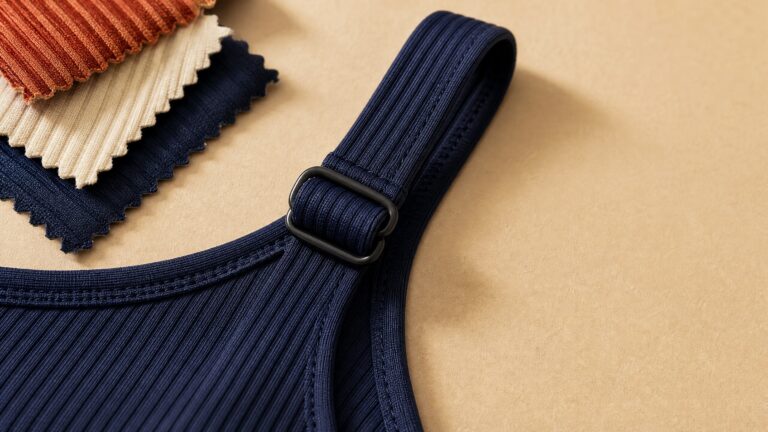
Start with a material reference that the supplier can identify. Record the elastic type, width, color, thickness or hand feel when relevant, and whether it will sit against the skin or remain enclosed. If a sample or supplier code has been approved, keep that reference with the bill of materials. Hongxiu’s fabric and trims sourcing service explains the information that helps a sourcing team match materials.
Ask for the replacement process too. An elastic that looks similar may recover differently after stretching or may feel firmer at the same width. A substitute should not enter production simply because the original is unavailable. Review it on the intended construction and garment zone first.
Set application length by garment zone
Do not use one tension rule for every edge. A supportive underbust band, a high-cut leg, a back neckline, and a shoulder strap have different jobs. The required hold also changes with fabric recovery, edge shape, seam construction, and the negative ease already built into the pattern.
For each zone, record the pattern edge length, elastic cut length, join allowance, and placement marks. Notches or quarter points help the sewer distribute the elastic instead of pulling most of the tension into one section. State whether the listed length is measured before joining, after joining, or on the finished garment.
The approved method belongs in the swimwear tech pack, ideally beside a construction sketch. A note such as “apply elastic evenly” is open to interpretation. A named elastic, cut length, join method, placement marks, and finished edge measurement give production and inspection the same reference.
Approve the result on the sample
The first calculation is a starting point. During swimwear sampling, check the garment relaxed, on the fit model, and after it has been put on and removed several times. Look for edge lift, rippling, uneven gathers, seam popping, pressure marks, and sections that lose their shape.
Fit comments should identify the zone and direction of the problem. “Leg feels tight” does not tell the pattern and sewing teams whether to change the elastic length, leg curve, garment measurement, or construction. A better comment records where the pressure occurs, how the edge sits, and which approved measurement is not being achieved.
Measure relaxed edges consistently
Finished elastic edges are easy to measure inconsistently. One inspector may follow the curve while another pulls it straight. One may stretch out puckers while another leaves the garment untouched. Define the measuring position, whether the edge follows a curve, and the amount of handling allowed before the reading is taken.
Keep this method aligned with the garment measurement chart. The guide to reviewing swimwear size grading explains why every point of measure needs one repeatable method. Elastic specifications should support those finished measurements rather than create a conflicting set of fit instructions.
Check tension again when sizes change
Grading the pattern does not automatically grade elastic application correctly. The relationship between the edge and elastic may need to change across sizes, especially at supportive areas or long curved openings. Fixed elastic widths can also feel different as coverage and body pressure change.
Review the approved base size and a size near the end of the intended range. Compare appearance, finished measurements, comfort, and recovery. If the larger size needs a different elastic length or construction detail, document that size break explicitly instead of relying on an operator to compensate at the machine.
Control elastic during bulk production
Before bulk sewing, confirm that the delivered elastic matches the approved reference and that the cutting instructions use the current lengths. Make a production sample with the actual shell, lining, thread, and elastic. Check its relaxed measurements and appearance against the sealed sample.
Inline checks should compare finished edges from more than one operator or machine. A stable average can hide one sewing station that is feeding elastic differently. Hongxiu’s swimwear quality control process provides the broader framework for pre-production, inline, and final checks.
Elastic approval checklist
- Identify the approved elastic by type, width, color, and supplier or sample reference.
- Assign an elastic cut length and placement method to each garment zone.
- Define how joins, notches, and tension distribution should be handled.
- Record the finished relaxed measurement and exact measuring method.
- Fit and review the base size plus a size near the end of the range.
- Require approval before an elastic substitution enters production.
- Compare the production sample and inline output with the sealed sample.
Give production one approved reference
Elastic problems often look minor on a table and become obvious only when the swimsuit is worn. The safest handoff combines the current tech pack, approved elastic, zone-specific application lengths, measurement method, and sealed sample. If one of those changes, update the reference before bulk sewing continues.
If you are preparing a new swimwear style, send Hongxiu the pattern or tech pack, elastic reference, target size range, and fit comments. The sampling team can help turn those inputs into a construction and approval reference that production can follow.