
The thread choice decides whether a swimsuit seam holds
A swimsuit can pass sample review with a seam that will not survive the pool. The fabric is right, the elastic tension was checked, the color matches the standard. Then the suit goes through ten chlorinated swims and the seam grins, or a thread breaks at the strap join.
Thread is usually the last component on the spec sheet. It also runs through every seam.
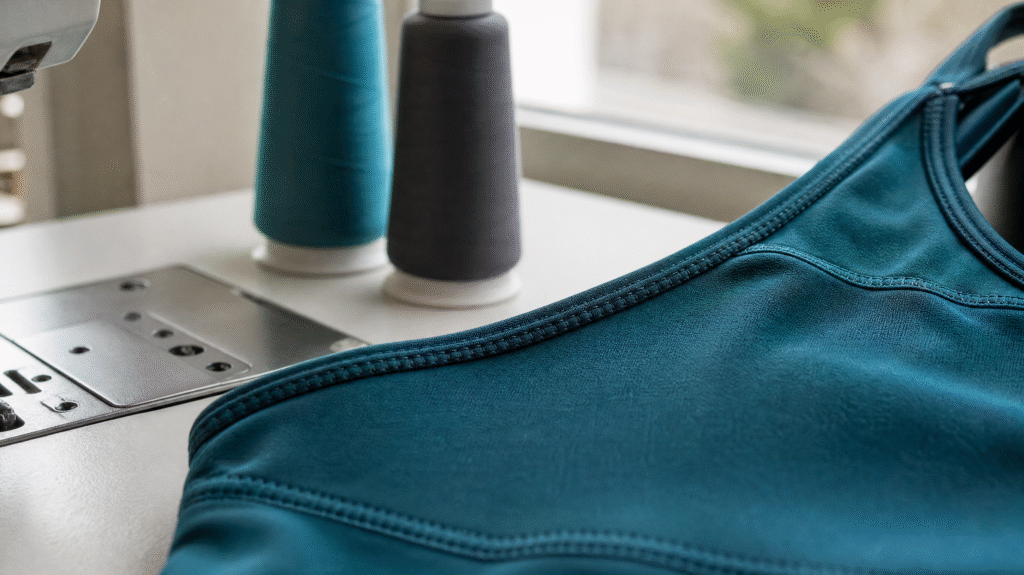
The blank line in the tech pack
Most swimwear tech packs give the shell, lining, elastic and trims a line each. Thread appears as “matching,” or it does not appear at all. The factory sews with whatever runs well on its machines: often a general-purpose polyester, or a nylon picked because it was in stock.
That default holds for most orders. Failures surface later, after the seam has been stretched, washed and exposed to chlorine. By then the thread sits inside a bulk order, and a change means reworking production.
You can leave most sewing parameters to the sample room. The thread still needs a name, a size and a test result on the approved sample.
A seam has to stretch with the fabric
Swimwear knits commonly stretch well past 50 percent across the width. A thread with less elongation than the fabric cannot follow it. The stitches crack open, or the thread takes the load and breaks.
Seam stretch needs a separate check from seam strength. A seam can hold a hard pull and still be wrong for swimwear because it will not extend. Pull the seam at a strap join or leg opening and watch the stitch line. Gaps that show fabric mean the seam is already at its limit.
Stress lands in the same places on most suits: strap attachments, center front, underbust elastic, leg openings. A flat side seam may never reveal a low-stretch thread. Elastic tension and strap construction both depend on a seam that can move. The swimwear elastic specifications and swimsuit strap construction guides cover those points in more detail.
Fiber choice is a trade-off
Thread selection starts with the fabric and the seam, not with a favorite supplier.
Nylon thread, including textured or woolly nylon, stretches well and feels soft against skin. It works in flatlock seams on stretchy knits and high-cut leg openings. Nylon is less resistant to chlorine than polyester, so a training suit that spends hours in a pool asks more of it.
Polyester holds up better to chlorine and UV light but has less stretch. A textured polyester recovers some of that. Put polyester in a seam on a very stretchy nylon-spandex knit and the seam construction has to give the thread room to move.
Cotton-covered thread has no place in a swimsuit. Cotton absorbs water, dries slowly and loses strength when wet.
The combination has to pass a seam test on the actual fabric. A thread that works on a dense polyester-spandex can fail on a lighter nylon tricot.
Size, finish and needle matter too
Thread size usually appears as a ticket number or tex. Finer thread suits lightweight, high-stretch fabrics and flatlock seams. Heavier thread suits covered elastic and topstitching, where the seam takes more abrasion. Too heavy a thread on a fine knit opens needle holes and puckers the seam. Too fine a thread breaks under tension.
Finish matters on a production floor. A lubricated thread runs cooler and breaks less often at high sewing speeds. Every break means a join, a re-stitch and a change in tension.
Needles belong in the same conversation. Ballpoint needles push between the yarns of a knit instead of cutting them. A sharp needle leaves a line of small holes that can grow into a seam failure. Stitch density and tension change the seam too. Too many stitches per inch stiffen it and reduce stretch. Too few leave gaps. Many swimwear seams run at roughly 10 to 12 stitches per inch, though the right number should be confirmed on the actual fabric and seam.
Color has to survive water, not just the color card
Thread is dyed separately from the fabric. A match that looks correct in an office can shift once the suit is wet and in sunlight. Dark threads may bleed or fade. Light threads can pick up a tint from the shell or from chlorine.
Ask for a colorfastness check on the thread with the actual shell fabric, not a generic thread card. When thread and fabric are different fibers, they age at different rates, and the seam becomes more visible over time. Reorders need the same thread lot. A new lot can read slightly different even when the code has not changed. Chlorine and sunscreen color testing is the place to catch that before bulk.
What to put in the tech pack
Write the swimsuit seam thread line so purchasing can buy it, the sample room can sew it, and inspection can compare it with the approved sample.
| Item | What to write | Why it matters |
|---|---|---|
| Fiber and type | Textured nylon, polyester or core-spun, matched to the seam and chlorine exposure | Fiber controls stretch, softness and aging |
| Size | Ticket or tex number | Size affects bulk, stretch and needle holes |
| Color | Thread code and lot reference, not only “match fabric” | Avoids a visible shade shift at the seam |
| Stretch | Elongation or seam stretch requirement | Keeps the seam moving with the fabric |
| Colorfastness | Chlorine, saltwater, light and wash | Catches fading and bleeding before bulk |
| Construction | Needle type, stitch type, stitches per inch, tension | Makes the seam repeatable across operators |
| Approval | Named supplier and a no-substitution note | Blocks an unreviewed swap |
A line item with a supplier, a number and a test result is enough.
How to check a sample
- Pull the seam at each stress point and compare it with the fabric. It should extend without cracked stitches or a hard stop.
- Mark a length of seam, extend it to the fabric’s working stretch, hold for a few seconds, release, and inspect. Look for broken filaments, skipped stitches and a seam that stays puckered.
- Wash and chlorine cycle a sewn sample, not only a fabric swatch. Check color, seam grin and whether the thread has frayed.
- Cut a seam open and look at the thread. Needle cuts show as broken yarns in the fabric beside the stitch line, not just in the thread.
- Record the thread brand, ticket and lot with the approved sample. That record is what makes a reorder match.
These are the same checks that belong in swimwear quality control before the bulk shipment leaves the factory.
The cost is in the failure, not the thread
Thread is a small share of a swimsuit’s material cost. It rarely changes a quote. A bad seam costs more later: repairs, chargebacks, returns, or a customer who stops trusting the fit.
A factory may swap in a thread that is close in color and size because the approved one is out of stock. Without a named reference and a no-substitution note, that swap can pass through purchasing without anyone noticing. By the time bulk lands, the seam has already been sewn.
A short rule for the next sample
Ask for the fiber, size, color reference and seam test result before you approve the sample. Keep the same thread lot for the reorder. If the factory cannot name the thread, ask why.
At Hongxiu, OEM production starts with a sample, and the approved sample becomes the production reference. If you are preparing a tech pack for an OEM or ODM program, our OEM swimwear manufacturing team can review the seam spec before sampling starts.