
Before your swimwear order ships, agree on what counts as a defect
Most buyers treat final inspection as the last box to tick. The order is made, the inspector visits, and the report comes back with a pass or a fail. But an inspection can only measure against a standard that already exists. If nobody wrote down what counts as a defect on this style, the inspector is making judgment calls, and the report will not tell you whether the order is genuinely ready to ship.
Swimwear makes that problem worse. A bikini or one-piece has stretch, print placement, small hardware, and very little margin on fit. Two inspectors can look at the same garment and reach different conclusions about a wavy hem or a print that drifts at the side seam. Agreeing a defect standard before production starts gives the inspection something concrete to check.
Make the approved sample the physical standard
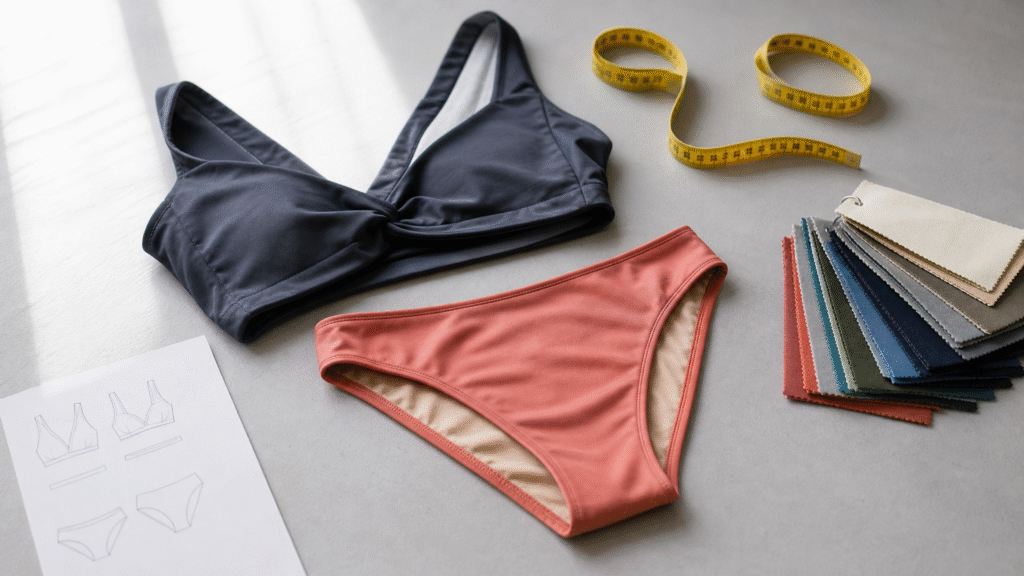
An inspection needs a reference. That reference is the approved sample, not a photo in a chat thread and not the original design idea. Before bulk begins, confirm which sample is approved, who signed it off, and where it will be kept, so your team and the factory are checking against the same garment.
The sample should fix the details that are expensive to argue about later: measurements, color, trims, hardware, stitch type, and workmanship. Our quality control process checks samples against your spec and confirms them with photos or video before shipping. If the sample is not locked, inspection has no baseline, and every disagreement becomes a matter of opinion.
Define critical, major, and minor defects before the order ships
A useful defect standard separates three levels. Critical defects make the product unsafe or unsellable and should have zero acceptance. Major defects affect how the garment fits, performs, or sells, and are judged against an agreed limit. Minor defects are cosmetic and usually fixable.
For swimwear, those levels look different from a general apparel checklist:
| Level | Swimwear examples |
|---|---|
| Critical (zero acceptance) | Exposed sharp or broken hardware; a closure that cannot be fastened; a size or fiber label that is materially wrong; a strap or cup that fails during wear |
| Major | Elastic that does not recover after stretching; seam slippage along a high-stress seam; print misalignment that shows when the garment is worn; measurements outside the agreed tolerance; a color that does not match the approved lot |
| Minor | Loose threads; a light surface mark that cleans off; a slightly uneven edge that does not affect fit |
Write the list in plain language and attach it to the purchase order. An inspector who has the list can classify a defect on the spot instead of flagging everything as a comment.
Choose a sampling plan that matches your order and your risk
Acceptable quality limit (AQL) sampling comes from ISO 2859-1 and is the common way to decide how many pieces to inspect and how many defects are acceptable. Apparel programs often use general inspection level II with AQL 2.5 for major defects and 4.0 for minor defects, and zero for critical. Those numbers are conventions, not rules. The point of AQL is to give both sides the same decision: pass the lot, or hold it.
A standard single sampling plan can still miss a low-rate defect, so AQL is not a promise that the order is flawless. A small order also produces a small sample, which makes each inspected piece carry more weight. If a style is print-heavy, hardware-heavy, or a first run, look more, not less.
Inspect in process, and again before packing
Final inspection catches what production already produced. In-line checks catch a problem while it is still cheap to fix. For swimwear, three points are worth watching: after cutting, when print panels are joined, and when elastic and straps are attached. Print alignment at the side seam and elastic tension are both easier to correct before the garment is finished.
The final inspection should happen after production is complete but before packing, so a failed lot is not already sealed in cartons. If you use a third party, book the visit in advance. Inspection agencies need lead time, and a late booking can push your ship date. If your own QC team visits, the same rule applies. Our swimwear sampling stage is where these checkpoints are agreed, and the size guide is the reference for flat measurements.
Prepare the measurement checklist and the paper trail
An inspection report is only useful if it records what was checked. Bring a point-of-measure list from the tech pack, with a tolerance for each point, and measure garments flat against the approved sample. Photos matter too. A description of a print that drifts is weaker than a photo with the measurement written next to it.
Keep the same checklist for reorders. Color, handfeel, and elastic tension can shift between runs, and a reorder inspection should compare against the retained sample as well as the spec. Our fabric guide explains the material factors that most often change from lot to lot.
Decide what happens if the order fails
Agree on remedies before you need them. If the inspection finds a failed lot, the realistic options are rework and reinspection, sorting the good pieces from the bad, a negotiated adjustment, or rejection. Rework is normal for minor and many major defects, but it only works if someone confirms the fix with photos or a second check before shipment. Our quality control process includes reinspection after rework for that reason.
Decide who pays for a re-inspection, who owns the deadline if rework delays the ship date, and what evidence closes the issue. A short clause in the purchase order is enough. Without it, a failed inspection turns into a negotiation under time pressure.
Inspection supports a decision, it does not replace one
An inspection earns its cost when it tells you, early enough to act, whether this order can ship as it stands. That call depends on a sample everyone trusts, defect definitions in writing, and a sampling plan chosen for the risk of the style.
If you are planning a first order or a difficult print, we can walk through the checkpoints with you before production. See our swimwear manufacturing services for how sampling, production, and inspection fit together.