
swimwear manufacturer&supplier in China – Hongxiu Clothing Co., Ltd.

Launching a swimwear brand requires a manufacturing strategy that balances quality, cost, and risk. For startups, sourcing from China offers significant advantages but introduces specific challenges around communication, minimums, and production complexity. This guide provides actionable steps to navigate the process, protect your capital, and establish a reliable supply chain from the outset.

Your Tech Pack: The Non-Negotiable Blueprint

Ambiguous instructions lead to costly errors. Your technical package is the contract between your vision and the factory’s execution. A comprehensive tech pack eliminates guesswork, ensures accurate costing, and sets the standard for quality. Investing time here saves weeks of sample revisions.

A professional swimwear tech pack must include several critical components:

  • Technical Flats: Digitally drawn, scaled illustrations showing front, back, and side views. Every seam, stitch line, and hardware placement (like rings and sliders for straps) must be clearly detailed.
  • Graded Size Spec Sheet: A complete measurement chart for every size (e.g., XS-XL). Include bust, underbust, waist, hip, torso length (high point shoulder to crotch), and leg opening height. Never assume a factory’s standard grading aligns with your fit model.
  • Bill of Materials (BOM): An exhaustive list of every component: primary fabric (specify composition like 80% Nylon/20% Spandex and weight in GSM), lining, elastics (width and composition), all hardware (hooks, rings, sliders), thread, and branding trims.
  • Construction Notes: Specify seam types (e.g., 4-needle flatlock for comfort seams, coverstitch for hems), seam allowances in centimeters or inches, and finishing techniques like bar-tacks at stress points.

A precise tech pack allows factories to provide a firm quote and delivers a first sample you can actually evaluate, not just a rough interpretation.

Strategic Fabric Sourcing and MOQ Management

Fabric is your largest cost and the core of product performance. For a new brand, managing fabric Minimum Order Quantities (MOQs) is a direct exercise in cash flow management. Your most strategic decision involves color selection.

Choosing between custom-dye and stock fabric colors is pivotal. Custom dyeing enables a unique brand palette but typically carries high MOQs (often 1,000-3,000 meters per color) and longer lead times. This commits significant capital to a single color before any market validation.

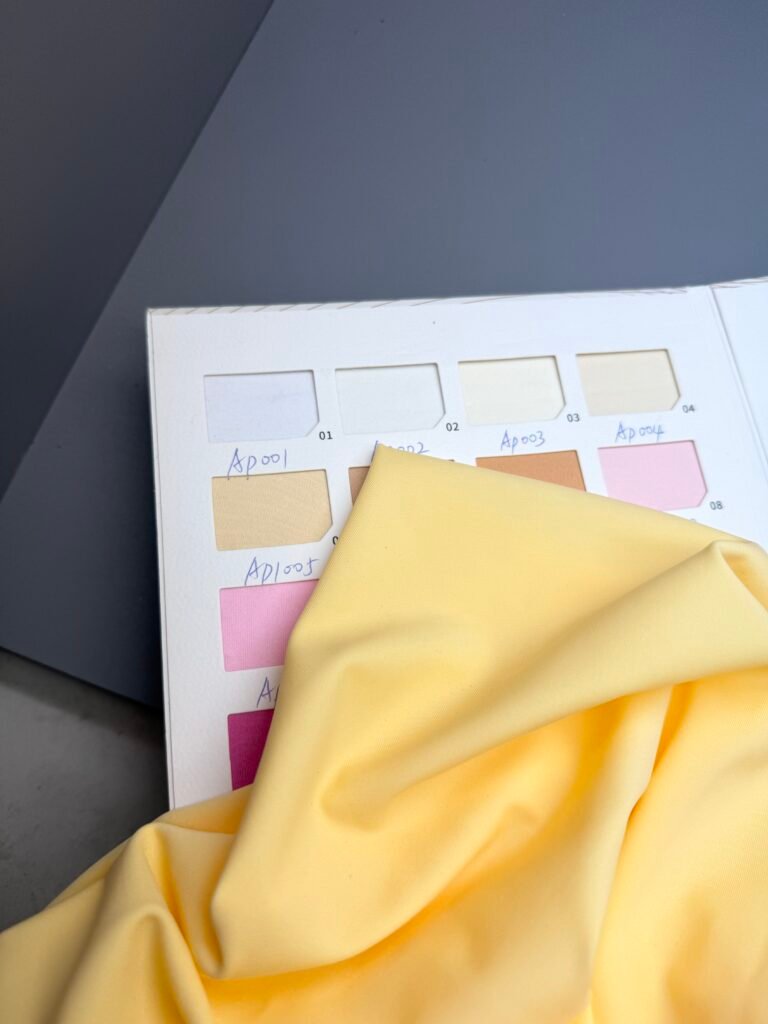
Yellow stretch swimwear fabric sample (Ap1005) displayed over color swatch book with labeled shades for B2B swimwear manufacturer production.

Partnering with a swimwear factory that maintains an extensive stock color library, as shown above, offers startups a pragmatic path forward. Sourcing from such a supplier provides key advantages:

  • Lower Financial Risk: MOQs for stock colors are significantly lower, sometimes allowing orders by the roll (e.g., 50-100 meters). This lets you test multiple colors in the market without excessive inventory.
  • Faster Time-to-Market: Fabric is available immediately, shaving weeks off your production timeline compared to custom dyeing.
  • Consistent Quality: Stock fabrics are typically from established, high-quality mills and have been pre-tested for chlorine and UV resistance, colorfastness, and recovery.

Beyond color, fabric composition is critical. For performance swimwear, a blend of 80% Nylon and 20% Spandex (Lycra® or equivalent) is standard for its durability, recovery, and comfort. Lighter fabrics (around 180-200 GSM) are ideal for bikinis and athletic styles, while one-pieces may use slightly heavier (200-220 GSM) material for better opacity and support. Always request fabric test reports for chlorine resistance (ASTM D7266) and colorfastness (AATCC 61-2A).

Critical Production Processes Beyond Basic Sewing

Quality swimwear manufacturing involves specialized techniques that go far beyond standard garment sewing. Understanding these processes helps you evaluate a factory’s true capability and set realistic quality expectations.

Cutting: High-quality swimwear factories use laser or ultrasonic cutting machines. These methods seal the fabric edges as they cut, preventing fraying of the synthetic fibers. This is crucial for maintaining the integrity of the garment, especially for high-stretch areas. Manual or die-cutting can lead to inconsistent pieces and frayed edges that compromise fit and longevity.

Seam Construction: The type of seam directly impacts comfort, durability, and appearance. Key seam types include:

  • 4-Needle / 6-Needle Flatlock: Creates a flat, comfortable seam ideal for side seams and areas that contact the skin. It’s strong and allows for maximum stretch.
  • Coverstitch: Used for hemming leg and neck openings. It provides a clean finish and good stretch recovery.
  • Safety Stitch (Overlock with a Chainstitch): A secure seam often used for attaching lining or for seams that won’t be against the skin.

Elastic Application: This is a skill-intensive process. Elastic must be applied with consistent, precise tension—too loose and the garment loses support; too tight and it becomes uncomfortable and can cause the fabric to ripple. Look for factories that use specialized elastic feeders on their machines for uniformity.

Hardware Attachment and Bar-Tacking: All stress points—where straps attach, hook & eye closures, and any D-rings—must be reinforced with bar-tacks. A proper bar-tack is a dense zigzag stitch that distributes stress and prevents tearing. Ask your manufacturer about their bar-tacking specifications and machine calibration.

Selecting and Vetting Your Manufacturing Partner

Choosing the right factory is your most critical sourcing decision. For a startup, the ideal partner is not necessarily the largest, but one experienced in handling smaller, detail-oriented orders and willing to grow with you.

Due Diligence Checklist:

  • Request a Factory Audit or Virtual Tour: Ask for photos or a video walkthrough of their production floor, cutting room, and quality control station. Look for organization, cleanliness, and modern equipment.
  • Ask for Client References: Specifically request contacts for brands of a similar size or stage as yours. A factory that only works with mega-brands may not be set up for your lower MOQs.
  • Evaluate Communication: Responsiveness and clarity during the quoting stage are strong indicators of future project management. Do they ask insightful questions about your tech pack? Do they provide detailed, line-item quotes?
  • Assess Specialization: A factory that produces both denim and swimwear is likely a master of neither. Prioritize suppliers whose core business is activewear, lingerie, or specifically swimwear. They will understand the unique fabric handling and construction requirements.
  • Inquire About In-House Capabilities: Does the factory source fabric themselves, or are you expected to provide it? An integrated factory with strong fabric supplier relationships can streamline your process and ensure material quality.

When reviewing quotes, look beyond the unit price. Scrutinize costs for sampling, shipping, and any potential hidden fees. A slightly higher unit price from a more communicative, transparent factory often results in lower total cost by avoiding costly errors and delays.

Managing Timelines and Implementing Proactive Quality Control

Realistic timeline management is essential for startup planning. From initial contact to finished goods, a typical first order cycle for swimwear in China is 12-16 weeks, assuming no custom fabric dyeing. Break this down:

  • Weeks 1-2: RFQ, factory vetting, and contract negotiation.
  • Weeks 3-5: Prototype sample development and approval (1-2 rounds).
  • Weeks 6-8: Pre-production sample (PP sample) made with correct fabrics and trims. This is your final sign-off before bulk production.
  • Weeks 9-14: Bulk fabric procurement (if not in stock) and production.
  • Weeks 15-16: Final inspection, packing, and shipping.

Build in at least a 2-week buffer for unexpected delays. Never finalize your marketing launch date based on the factory’s “best-case” timeline.

Proactive Quality Control (QC): Don’t wait until the end of production to check quality. Implement a three-stage QC protocol:

  1. During Production (DUPRO): After 10-20% of the order is completed, request photos or a video of in-process garments. Check for consistent stitching, elastic application, and color matching. Catching an issue here allows for immediate correction on the production line.
  2. Pre-Shipment Inspection (PSI): When 80-100% of the order is packed, conduct a full AQL (Acceptable Quality Level) inspection, either by hiring a local third-party inspector or by having the factory send detailed reports and photos. Standard for apparel is AQL 2.5 for major defects and AQL 4.0 for minor defects.
  3. Measurements Check: Randomly select packed garments and have the factory measure them against your spec sheet. This verifies that grading was executed correctly.

Provide your factory with a clear QC checklist that mirrors your tech pack, specifying exactly what constitutes a major vs. minor defect.

Building a Partnership for Scalable Growth

Your initial order is the foundation of a long-term relationship. A good manufacturer views you as a partner, not just a transaction. Foster this relationship through clear communication and fair business practices.

Be transparent about your growth projections. If you plan to scale from 500 to 5,000 units in the next 18 months, let them know. This allows them to plan capacity and potentially offer more favorable terms as your volumes increase. Discuss payment terms openly; starting with a 50% deposit and 50% before shipment is standard. As trust builds, you may negotiate better terms.

Provide constructive feedback. After you receive the goods, share detailed notes on what was excellent and what could be improved for the next order. This collaborative approach turns your manufacturer into an extension of your team, invested in your brand’s success. They can often provide valuable insights on cost-saving design tweaks, new fabric innovations, or more efficient production methods for future collections.

Finally, plan for diversification early. Relying on a single factory is a risk. Once your first supplier relationship is stable, use the same rigorous process to identify a secondary or backup manufacturer. This protects your business from unforeseen disruptions and gives you negotiating leverage.

By methodically addressing each of these areas—from your initial tech pack to fostering a true partnership—you transform the complex challenge of sourcing swimwear in China into a structured, manageable process. This disciplined approach minimizes risk, protects your startup capital, and builds a supply chain capable of supporting your brand’s growth for seasons to come.