
The future of China’s swimwear manufacturing industry is not a question of decline, but of strategic evolution. For global brands, retailers, and wholesalers, the next decade of sourcing will be defined by how suppliers navigate fundamental demographic shifts and rising operational costs. The industry is consolidating around three core strategic paths: geographical relocation, technological integration, and a fundamental shift toward specialized, value-added services. Your supplier’s chosen trajectory will directly impact your product costs, quality consistency, and capacity for innovation.
The Demographic Imperative Reshoring Production Costs
The most significant, irreversible force shaping the industry is demographic change. The generation that built China’s manufacturing dominance is retiring, and fewer young workers are pursuing careers in industrial sewing. This is a structural labor shortage, not a temporary market fluctuation. In established coastal hubs like Xingcheng, Liaoning—historically a global swimwear production center—this scarcity has driven wages up consistently. For buyers, this translates directly to higher FOB prices as factories pass on increased labor costs to maintain margins. The factory address listed on a supplier’s website from five years ago may no longer reflect where your garments are actually cut and sewn today, as production quietly shifts in search of accessible, affordable labor.
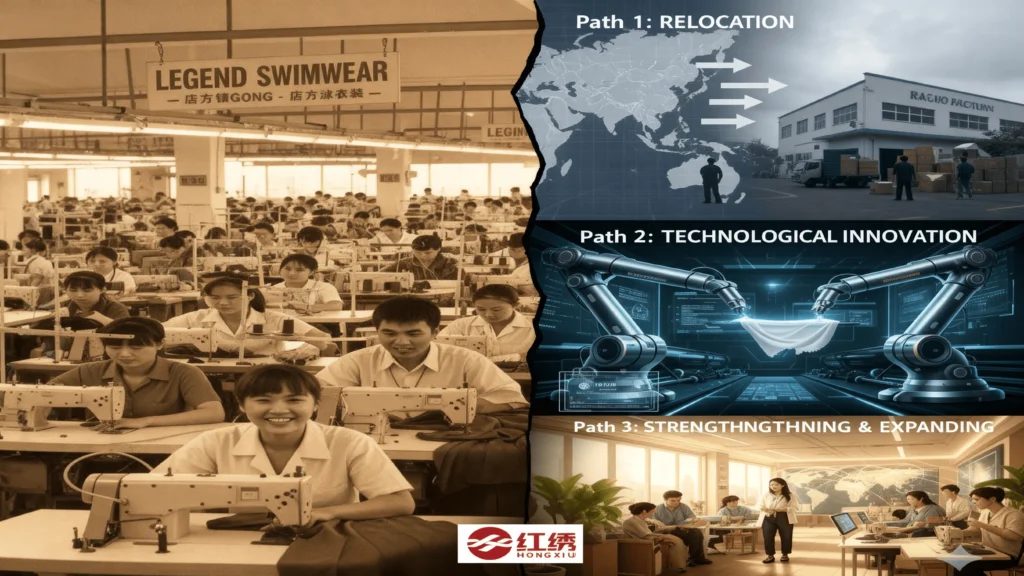
Path 1: Strategic Relocation Within and Beyond China
Relocation is the most immediate response to cost pressures. This movement often happens in two stages. First, production shifts inland to neighboring provinces or counties with lower wage expectations. Following the Xingcheng example, many factories have expanded operations to areas like Kazuo and Lingyuan, where labor pools remain more robust. The second stage involves international expansion, primarily to Southeast Asia (Vietnam, Cambodia, Bangladesh) for high-volume, basic style production.
For procurement teams, supplier relocation presents a complex trade-off:
- Potential Advantages: Lower unit costs for basic items, access to newer labor markets, and potential tariff advantages (e.g., exporting to the EU or US from ASEAN countries under preferential trade agreements).
- Critical Risks: Quality control can be inconsistent during the setup and training phase in a new location. Supply chain lead times often become longer and less predictable. Communication and oversight become more challenging with greater geographical and cultural distance. Intellectual property protection may be weaker in some jurisdictions.
When evaluating a supplier pursuing this path, ask specific questions: How long has the satellite facility been operational? What percentage of management and technical staff is from the original Chinese factory to ensure process transfer? Can you audit the new facility directly?
Path 2: Incremental Technological Integration
Instead of chasing cheaper labor, some manufacturers are investing to make their existing workforce more productive and less replaceable. This path focuses on technological upgrades that augment human skill, not fully replace it. The goal is to stabilize quality and output despite a shrinking labor pool.
Key areas of investment include:
- Automated Cutting: Computer-controlled cutting machines drastically reduce fabric waste (often by 5-8%) and improve cutting precision for complex prints and patterns.
- Specialized Sewing Machinery: Automated bartackers, coverstitch machines with laser guides, and programmable elastic applicators increase stitching speed and consistency for critical operations like attaching straps and leg bindings.
- Digital Pattern Making & Grading: 3D prototyping software allows for virtual fit sessions, reducing physical sample rounds from 3-4 to 1-2, shortening development time by weeks.
- Production Management Software: Real-time tracking systems from cutting to packing improve workflow visibility, reduce bottlenecks, and provide more accurate delivery forecasts.
This approach prioritizes stability and precision over lowest possible cost. It benefits buyers who require consistent quality, complex technical construction (like molded cups or bonded seams), or smaller, more frequent orders that don’t justify the minimums of a relocated mass-production line.
Path 3: Developing In-House Design and Specialization
The most significant long-term shift in China’s swimwear production is the move from pure contract manufacturing to integrated service provision. Forward-thinking factories are cultivating in-house design teams and developing deep technical expertise in specific niches. This transforms the buyer-supplier relationship from transactional to collaborative.
This specialization manifests in several ways:
- Material Innovation Hubs: Factories develop proprietary fabric libraries, partnering with yarn spinners and knitters to create exclusive recycled polyesters, chlorine-resistant blends, or specialty textures. They can advise on the optimal fabric for a design’s intended use (e.g., athletic training vs. resort wear).
- Technical Category Experts: Some manufacturers focus exclusively on performance swimwear for athletics, mastering the construction of drag-reducing suits, bonded seams, and compressive fabrics. Others specialize in luxury resort wear, with expertise in delicate embellishments, intricate cut-outs, and premium linings.
- Integrated Design & Development: An in-house design team can take a buyer’s concept sketch or mood board and develop it into a production-ready tech pack, including detailed flat sketches, graded spec sheets, and a bill of materials. This reduces the burden on the buyer’s own product development staff.
This path adds value beyond stitching fabric. It turns the factory into a true development partner capable of solving problems and driving innovation, which is crucial for brands competing on design and performance rather than price alone.
Building a Complete Service Ecosystem for Brands
The evolution of China’s swimwear sector is culminating in the creation of full-service ecosystems. Leading suppliers no longer just manufacture; they orchestrate the entire process from concept to delivery. This model is particularly valuable for small to mid-sized brands and retailers that lack large in-house sourcing and logistics teams.
A comprehensive service ecosystem typically includes:
- End-to-End Material Sourcing: Managing relationships with fabric mills, trim suppliers, and accessory vendors. The factory handles quality testing, bulk ordering, and inventory management of all components, ensuring consistency and simplifying the buyer’s supply chain.
- Quality Assurance as a Standard Process: Implementing a multi-stage inspection protocol that includes in-process checks during cutting and sewing, pre-final assembly audits, and final random inspection (AQL) before packing. Detailed inspection reports are provided transparently.
- Logistics and Compliance Management: Handling all export documentation, customs clearance, and freight forwarding. Experienced suppliers stay updated on changing international regulations, such as labeling requirements, chemical restrictions (REACH, CPSIA), and sustainability certifications needed for key markets.
- Small-Batch and Sampling Agility: Offering flexible production lines that can efficiently handle low-minimum development samples and small production runs (e.g., 300-500 pieces per style), enabling brands to test the market without massive inventory risk.
This integrated approach reduces the number of points of failure in your supply chain and consolidates accountability with a single partner.
Evaluating Your Current and Future Swimwear Supplier
In this evolving landscape, a static supplier assessment is insufficient. Buyers need a dynamic framework to evaluate partners based on their strategic direction. Use this checklist during your next factory audit or capability discussion.
Strategic Direction & Transparency
- Does the factory openly discuss its 5-year plan regarding labor, location, and technology?
- If relocating, what is the timeline and what safeguards are in place for quality and communication during the transition?
- What specific technology investments have been made in the last 18 months, and how have they improved efficiency or quality?
Operational Capability & Specialization
- What is the factory’s true specialization (e.g., athletic, luxury, sustainable basics)? Ask for case studies or client references in that niche.
- What percentage of the design and development process can they manage in-house? Request to meet the design team.
- How do they source and test materials? Do they have a physical fabric library you can review?
Resilience & Service Integration
- What is their business continuity plan? How would they handle a disruption in one production location?
- What specific services beyond manufacturing do they provide (logistics, compliance, QC management)? Are these services managed internally or subcontracted?
- What is their communication protocol? Who is your single point of contact, and what are the standard reporting intervals for production updates?
Cost Structure Realism
- Are their price quotes transparent, with clear breakdowns for fabric, labor, overhead, and profit? Be wary of quotes that seem unsustainably low.
- How do they explain cost increases? A professional supplier should be able to articulate cost drivers (e.g., fabric market increases, wage adjustments) rather than just issuing a new price.
- Do they offer different pricing tiers based on service level (e.g., full-package vs. CMT)?
The future of sourcing swimwear from China requires a more engaged, strategic partnership. The most successful buyers will align with suppliers whose chosen path—whether relocation, technological investment, or deep specialization—matches their own brand’s priorities for cost, innovation, and supply chain resilience. The goal is not just to find a factory for today’s order, but to identify a manufacturing partner capable of evolving alongside your business for the next decade.