
swimwear manufacturer&supplier in China – Hongxiu Clothing Co., Ltd.

Approving comprehensive samples from your swimwear manufacturer before committing to bulk production is the most effective way to de-risk your investment. This process transforms your design concept into a tangible, testable product, providing concrete evidence that your custom swimwear can be manufactured at scale with consistent quality, fit, and durability. For brands and retailers, this staged validation is not an optional extra but a core component of technical due diligence, protecting both your financial outlay and your brand’s reputation.

The Business Case for a Structured Sampling Protocol

Swimwear sourcing presents unique technical challenges. The combination of high-stretch fabrics, specialized construction techniques like flatlock or coverstitch seams, and the non-negotiable demand for flawless fit in active, wet conditions means that minor miscalculations in the prototype stage can lead to catastrophic losses in bulk. A professional sampling protocol systematically answers critical commercial questions: Is the design structurally sound for its intended use? Does it fit the target body consistently across the size range? How will the fabric, elastics, and hardware perform after repeated exposure to chlorine, saltwater, UV, and wear?

By approving a set of validated samples before authorizing full production, you transfer the technical execution risk from your brand to the factory. These approved samples become the legally binding standard for the entire order, a physical contract that ensures your final shipment matches your expectations.

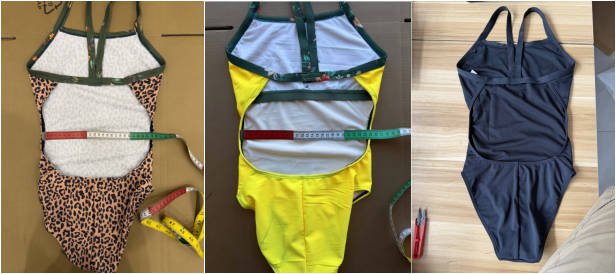
Leopard-print and yellow one-piece swimwear with green trim, plus black backless style, all laid flat with measuring tapes for size verification during production.

The Five-Stage Development Process for Swimwear Samples

A thorough sampling cycle isolates and resolves potential issues at sequential checkpoints. Partnering with experienced custom swimwear manufacturers who adhere to this staged approach provides clarity and control from sketch to shipment. Each stage serves a distinct purpose, building confidence before you commit significant capital.

1. Proto Sample: Validating Design Feasibility

The proto sample is the first physical translation of your tech pack or sketches. Its primary goal is to test the fundamental manufacturability of the design. The factory’s technical team typically uses a similar, readily available fabric (not the final bulk fabric) to construct this sample. They assess the pattern’s integrity, the logical placement of seams and hardware like rings and sliders, and whether the design can be efficiently assembled on a production line without unnecessary complexity. This stage identifies major structural red flags—such as a strap attachment point that creates a weak seam or a cut that is impossible to sew accurately—long before more expensive materials are committed.

2. Fit Sample: Analyzing Ergonomics and Movement

Swimwear must perform in motion, not just on a hanger or a dress form. Fit samples are crafted in a fabric with stretch and recovery properties nearly identical to the final specified material. These samples are tested on live models whose measurements precisely match your target size spec. The evaluation goes beyond static fit to check for dynamic issues: Does the fabric migrate or shift during activity? Do straps slip off the shoulder? Is there excess tension or gapping in key areas when the model moves, bends, or swims? This stage is crucial for activewear-inspired swim designs or any piece where security and comfort during movement are paramount.

3. Salesman Sample (SMS): Your Commercial Prototype

The Salesman Sample is the first sample made in the exact final fabrics, colors, and trims. Its purpose is commercial: to be used for marketing photography, pre-sales to buyers, or crowdfunding campaigns. It represents what you intend to sell. Evaluating the SMS allows you to confirm color accuracy under different lighting, the hand-feel of the fabric, and the overall aesthetic appeal. Any discrepancies between the approved lab dip and the actual fabric roll will become apparent here.

4. Pre-Production (PP) Sample: The Binding Production Standard

The Pre-Production sample is the most critical sample in the process. It is produced on the actual production line, using all bulk materials, by the workers who will make the full order. This sample is your final opportunity to approve or reject the standard for mass production. Once you sign off on the PP sample, you are approving it as the official reference for quality, measurements, construction, and finish. All bulk goods will be inspected against this sample. It is the tangible, legal benchmark for your order.

5. Top of Production (TOP) Sample: Verifying Line Consistency

After bulk production begins, the factory should pull the first few pieces off the line to create TOP samples. These are sent to you for verification that the mass-produced items consistently match the approved PP sample in every detail. Checking TOP samples confirms that the production line is calibrated correctly and that quality is being maintained from the very start of the run. It’s a final safeguard before the entire order is completed and shipped.

How to Professionally Evaluate Swimwear Samples

Effective sample evaluation requires a systematic approach beyond a simple visual check. Create a standardized checklist for each stage. For fit samples, this includes measuring against the spec sheet (allowing for fabric stretch tolerances) and conducting wear tests for a minimum of 30 minutes of activity. For PP samples, your inspection must be exhaustive:

  • Measurement Audit: Measure every key point (bust, waist, hip, leg opening, strap length) and compare to the graded spec sheet. Understand the acceptable tolerance (e.g., ±¼ inch or ±0.5cm).
  • Construction & Stitching: Check seam consistency, stitch density (SPI), and the appropriate stitch type (flatlock for comfort, coverstitch for hemming). Look for skipped stitches, loose threads, or uneven tension.
  • Fabric & Trim Alignment: Verify that prints are matched at seams correctly and that any hardware is securely attached and functioning smoothly.
  • Finishing: Inspect the cleanliness of the inside: are seam allowances neat? Are labels correctly placed and sewn? Is any excess lining or elastic trimmed?
  • Wash Test: Subject the sample to a simulated wash and wear cycle. Wash it according to care instructions, let it air dry, and check for color bleeding, shrinkage beyond tolerance, or distortion of shape.

Realistic Timeline from Design Handoff to Bulk Delivery

Understanding the timeline is essential for planning your collection launch. Rushing any stage increases risk. A typical timeline with an experienced factory looks like this:

  1. Proto Sample: 7-10 working days after tech pack approval and fabric sourcing.
  2. Fit Sample & Revisions: 10-14 days per round. Most styles require 1-2 fit sample rounds.
  3. SMS Sample: 10-12 days after final fit approval and bulk fabric arrival.
  4. PP Sample: 7-10 days after SMS approval and all bulk materials are in-house.
  5. Bulk Production: Duration depends on order quantity and complexity, typically 30-45 days for a medium-sized order.
  6. TOP Sample & Shipping: TOP samples can be sent 5-7 days after production starts. Shipping adds 20-40 days depending on destination and method (sea/air).

Factor in at least 4-5 months from initial design handoff to having goods in your warehouse. Complex prints, custom-dyed fabrics, or novel hardware will extend this timeline.

Key Red Flags in a Factory’s Sampling Approach

Be wary of manufacturers who cut corners in sampling, as it indicates deeper issues with quality control or professionalism.

  • Pushing to Skip Stages: A factory suggesting you skip the fit sample or combine the SMS and PP sample is prioritizing speed over your product’s integrity.
  • Unwillingness to Revise: Professional factories expect and plan for revisions. A defensive attitude toward necessary changes is a bad sign.
  • Using Different Materials: If fit samples are made in a fabric vastly different from your specified material, the feedback is worthless.
  • Vague or Missing Spec Sheets: The factory should provide detailed measurement reports with each sample. Lack of documentation shows a lack of process.
  • High Pressure to Approve: Pressuring you to approve a sample “to save time” when you have unresolved concerns is a major red flag.
  • No TOP Sample Offer: Not offering to provide TOP samples suggests they are not monitoring line consistency or do not want you to see the initial output.

Assessing a Manufacturer’s Sampling Capabilities

Before you commit to a factory, due diligence on their sampling process is crucial. Ask direct questions during your sourcing phase:

  • “Can you walk me through your standard sampling stages and timeline for a custom swimwear order?”
  • “Do you have in-house pattern makers and sample machinists dedicated to development, or is this work done on the main production line?” (The former is preferable).
  • “What is your policy on sample revisions? How many rounds are typically included in the development cost?”
  • “How do you document and communicate changes between sample rounds? Do you provide annotated photos and updated measurement charts?”
  • “Can you provide examples of spec sheets and approval forms you use with clients?”
  • “For fit testing, do you have models on staff or on call that match standard size specs?”

Visit the factory if possible, or request a virtual tour focusing on the sample room. A clean, organized sample room with skilled technicians is a strong indicator of a factory’s commitment to quality development. The cost of comprehensive sampling is an investment, not an expense. It is far cheaper to correct a flaw in a sample of one than to deal with 10,000 defective units in your warehouse. A transparent, collaborative sampling process with your chosen swimwear manufacturer is the foundation of a successful and scalable supplier relationship.